This year I finally realized, how insignificant and meaningless the NAMM show (the largest music- and audio technology exhibition) has become to me from a musical perspective. Most “new” products are all about either re-selling old ideas, re-creating vintage equipment from the ’70s & ’80s in a cheaper, plastic-y (but usually more amateur-proof, more convenient) package, or making complex or experience-based processes easy for beginners, so that they can get “professional” results with a push of a button, without needing to have a clue about what’s really happening in the background, and enjoy the results – which can sound just like their favorite “Major Artist” (more about this in a later post). So where are the truly creative products? Those that make you think and work harder to achieve genuinely different (dare I say: original) results, which will enrich the cultural legacy that we leave behind on this planet…? I can’t see very many.
Don’t get me wrong, I love to use technology; I have been using it for as long as I can remember working with audio and music (28+ years). The trend I’m really not interested in, and frankly I’m against, is how digital technology is making humanity lazier, easier to get impressed, but less skilled, way less creative, and ultimately less happy. We can’t even begin to describe the difference between how Schaeffer or Moog must have felt when creating something original, never before heard/seen, and how users feel today when they finally figure out how they can get to a menu in their newly upgraded software. I’m certainly not criticising the advantages that technology brings to the medical fields, to various sciences or to the military, and not disputing its benefits (at least for their respective users) either. My issue starts where technology becomes more than a tool, it becomes a way of thinking, a way of life: it becomes the purpose. The time when you start depending on technology to carry out fundamental human actions (cooking, entertainment, learning, creating art or simply being happy) and to interact with others (communication or expressing emotions in other ways), is precisely the point when it starts making you, and your creations, less human. I believe that a large portion of our society has already passed that point.
“Sure…”, you might think, “this is an old argument that I have heard many times”. I have, too, yet I don’t see that the majority would agree, and would stop supporting and praising the exponential technical “evolution” of the human race. Is it really evolution, when you become a technology-dependent user? I have been listening to some of my otherwise pretty smart friends for years, talking in awe about how fantastic their new xyz music production- or photography software is, because with it they can effortlessly and conveniently produce the “perfect” results (which, in my opinion, doesn’t exist anyway, not to mention that “perfect” should be a moving, evolving target, not a stationary idea). I understand that for those who can’t hum a tune or take a snapshot with a film camera, toys can be great; they let them play around and make fun things that otherwise they would not be able to. But, if you consider yourself an advanvced amateaur, not to mention a professsional… your goal should definitely not be making your pieces to sound or look like the mainstream, nor to get results in a convenient way thank to some dumbed-down processes.
I have recently watched the biographic movie of the late Joseph Weizenbaum, who realized the curse of AI (after spending the majority of his life as one of the pioneers who helped paving AI’s way), and in the same film, listened to the idiotic, demagogic (and surprisingly naive) monologues of self-proclaimed futurist, Ray Kurzweil. It’s a great documentary. Then, when further researching the subject, I came accross excerpts from the movie on YouTube, and sadly found that most user comments are blindly supporting Kurzweil’s ideas and are describing singularity as the ultimate human experience and heaven-like state achieved with technology. They just really don’t get it… does it seriously require so much of humanness in our hearts and brains to understand why you don’t want to become an always happy, “perfect” humanoid thing? Or, why it’s not a great idea to replace your good and bad memories with only positive ones, modified by ones and zeros custom-designed for you – and call it total happiness? I guess the “make it a good day” phrase would get a whole new meaning… Has Kurzweil not seen (or get the point of) Bruce Willis’ Surrogates? Instead of a “perfect” life for 150 years, I would personally go for a shorter one that is filled with realism and adventure – no question about it.
How ironic – from the ’60s through the ’80s, the “human machine” used to be a futuristic idea, which was different enough to be cool, but was not meant to be taken too seriously, at least not as a plausible and desirable future (nor did it take itself too seriously). From 1978 on, Kraftwerk’s Die Mensch Maschine let us imagine an alternate yet clearly fictional reality, it let us play the role of a machine – the keyword being play. Playing is imagining, imagining leads to creating. Creating means using our brain not to repeat, not to copy, not to imitate, but to invent what doesn’t exist yet, to express thoughts/feelings in ways that have not been expressed before, as each of us has a unique view. To enrich the human history with something that is fundamentally new and original, and human, something that wouldn’t exist without you or them or I creating it. Those were great times.
But, now in the 21st century, wealthy “futurist” tyrantopaths and powerful companies are actually making purpose-lost humans believe, that living a virtual or by-choice software-supported life is cool and that the convenience of imitation (as opposed to creation) is what will make everyone’s life better and happier. They state that a “perfect” human will have a “perfect life” (apparently they haven’t taken a look at depressed lottery winners, wealthy hardcore drug-addicts, alcoholic- and bankrupt celebrities, etc.). Hiding behind misused words (like creativity) and syrupy advertising (you can create anything), they are managing to convince a large portion of population, that by clicking around in a simplified, purpose-built software, the user can actually get really inventive and achive the euphoria of creating something totally new, that was only possible for those with some specialized equipment, extreme dedication and (too much) time a few decades ago. They’re smart marketers; “optical illusions have gotten old, let’s keep everyone entertained with the technical illusion (and make a few billions along the way)”.
What does all this have to do with the NAMM show and music composition/production? Technology in music has served humans really well until is was enabling us more to come up with new ideas than to replicate old ones easier. Just like in many other areas, it has become a simple, quick and cheap way for anyone to imitate ideas – ideas, which have been already conceptualized and executed a long time ago, by those who pushed the boundaries of their mind, not (just) the technology of their times. Those who got something more out of new technologies than the masses (think of tape recorders and musique concrete). Technology is not inspiring users to push the boundaries of originality in music or sound – despite of what your favorite music store’s email newsletter tells you. If you have listened to mainstream radio or have seen what’s been coming out of Hollywood for the past decade, you know what I’m referring to. (It would be nice to have a recognized and truly independent award for those rare exceptions).
I do think that there are no limits to the extent and form of originality that one can come up with in music and sound today, despite of the sheer volume of ideas that the entertainment industry has wasted as over-exploited musical products, which it shoved down the consumers’ throat, especially in the past thirty-plus years. Ideas are so much more powerful and diverse than technology is! I often tell my students not to let technology drive their creative decisions, but the other way around – the leaders of the music technology industry seem to be on the opposite side (unlike some exceptional, respectable small companies).
“I’m the artist of the future!” – Let’s make everything perfect, like on TV.
I urge programmers and software engineers to design products that help users to push the limits of our imagination, not the speed of the processors, and to contribute to the real progress of the human race, not products that make our lives overly comfortable and only seemingly happy. It might already be too late for that, as most users don’t realize how limiting this modern-day dependence actually is (try to get a sense for this dependence by turning off everything digital for a week in your house and at work), and they support it by favoring convenience and the illusion of their personal creative evolution, over creative thinking and hard work. This is especially true for today’s electronic music. Do unsuspecting users seriously think that the latest xyz plug-in that takes their sound closer to an [insert ‘major’ artist name] -track will open up their world of creativity and get their music launched into some brand new musical landscape? Do they seriously think that buying Native Instruments’ latest six-hundred-forty-million Terabyte sample library will help them to get their name written into the music history books? I hope you don’t. Real success happens when you are creating from your own, completely original ideas, your uniquely expressed feelings, personal experiences and memories that you turn into sound, music, image, etc., and when you let go of control and give space for happy accidents to happen.
According to Brian Eno, “Perfection is characterlessness”. I could not agree more. Throughout my career I have composed music both with the intention of creating “perfection” relative to industry expectations and trends, and also music not limited by particular guidelines or standards. I feel that my more predictable, more “perfect” pieces could have been created by many other composers… but those that were not born from the application of the established approaches, processes and techniques, but ventured off to take unplanned, untested directions while disregarding any routines or expectations, became the ones that would not exist without my existence – in turn, making my existence, and humble contribution to humans’ musical legacy, worthwhile.
My point? Next time when you’re enjoying the latest and greatest all-in-one easy-to-use music production software and feeling creative, challenge yourself by turning it off, grabbing a microphone and an object that you’d unlikely to ever record, or grab that $20 old toy synth (or other instrument with seemingly limited capabilities) from eBay, and start creating an experience. Instead of starting with a mass-produced algorhythm and your mouse, try some of the most human methods: discovery.
Singularity? The day when we trade our individuality for perfection – I despise that idea. We are alive as long as we are unique. Spending your money with companies that don’t sell you fake “creativity” but actually enable you to find your voice and ideas, will not only get you farther in your artistic endeavors today, but will help you to step on a currently unpopular road to an alternate, totally crazy, almost unimaginable and unbelievably human future as well: one with less perfection and less convenience.
SILICON VALLEY, CA / BUDAPEST, HUNGARY — Creative Shop Music has announced a planned 2014 release of a brand new concept work by composer Julius Dobos. The large-scale work in psybient / ambient-electronic style will encompass multiple album releases.
The composition and musical sound design process started in late 2009 and has been the main focus of Dobos since. The work is expected to be a reflection of Dobos’ philosophy about the relationship of Nature, Life, the Universe and music, touching on such intriguing subjects as the existence and relativity of space and time – expressed in music and sound. The first release in the series, while electronic in nature, will build on an organic feel and warm textures. The ambient yet rhythmically exciting music will feature lush soundscapes, complex, out-of-this-world sounds, haunting melodies, powerful emotions, instrumentation form minimal to grandiose, traveling through seven unique sonic landscapes.
The planned 2012 release date of the new work, which was first announced last year, has been delayed due to the relocation of Julius’ studio and recent teaching commitments, however the production is now at full steam at Studio CS. No further details or samples have been released, and the title of the work has not been made public either.
Be sure to check back often for announcements, or subscribe to the newsletter for the latest news.
“Analog, digital, virtual analog, software synths… which one is the best option? Which ones sound the best? This is one of the most frequent questions I get from my listeners, students and even friends from the music industry. So I thought I’d post my thoughts about this in a very condensed and non-technical form. Obviously, I won’t be comparing specific models or talk about the exceptions in this article, rather discuss the benefits/disadvantages of the four major categories in general (as for professional or advanced amateur studio use). So let’s go from the most fundamental to the more recent concepts.
Can a digital synth sound as good as an analog one?
Define good. A digital synth can sound horrible or it can sound way more interesting than an analog, depending on what type of sound and character you’re after. They both have strengths and weaknesses, and it simply doesn’t make sense to compare them without talking about some specific characters. For example, for sounds with a truly vintage character, for soft-saturation-rich sounds, for naturally unstable tones or somewhat uncontrollably fluctuating parameters, analog instruments will have an advantage, while most acoustic instrument imitations will sound quiet pathetic coming from analog electronic instruments. Besides actual samples of acoustic instruments, many digital synths will give you access to non-traditional parameters, diverse control options including MIDI, other than subtractive synthesis methods such as stable FM, PM, PD, additive, wavetable, granular, etc., and modeled analog component designs (algorithms), which might be unfeasible or practically impossible to build in the analog domain. So, get that old digital synth down from the attic.
Virtual analogs never sound as good as real analogs, right?
Wrong. Again, define good. The individual character of a virtual analog will likely come from different elements/attributes of the sound it produces than those of real analogs, and if that’s what you’re after, they might very well sound bigger, fatter, harsher, punchier than their analog relatives. Built-in effects may be available as part of the sound design process (as opposed to just system effects) in many of the virtual analogs (think of the Virus or the Supernova), and can often be controlled and routed in unconventional ways and interact with the more traditional attributes of sound. While virtual analogs will certainly have their own character, they will let you create sounds with a different character quite easily, as virtual analogs typically offer a large number of editable parameters, the non-traditional combinations of these, and highly flexible routing and control capabilities. Classic analogs have their individual character, which is fantastic, but might be somewhat more limiting when you’re trying to create sounds that don’t necessarily feature the typical character of a given model.
If you are using a VA and going for a classic”imperfection” (of steady pitch, amplitude, control and dynamic behavior) of a true analog sound, an often highly desirable character, you will have to imitate this imperfection by randomizing the value of several parameters– still, it just won’t be the same as the real thing. While the “warmth” of an analog synth can be described with an algorhythm and added to a virtual analog sound, a monotonously consistent (sampled) analog character or a digitally pre-programmed change of that character just won’t give you the same sonic quality and feel as the dynamically (and often randomly-and-dynamically) changing warmth and imperfection of a classic instrument. These exciting imperfections result from minor, unpredictable voltage changes, unrelated parameters’ coincidental effect on each other, use of a less consistently acting keyboard, difference in design (often no consistency there with hand-built models) and degree of stability between the oscillators, temperature changes, etc. Not to mention the unpredictable effect of a true analog instrument’s mood at a given time, i.e. what kind of day it’s having…
Do the new versions of vintage analog synths, those with fully analog signal paths (like the Voyager, MS-20 mini, OB 2-voice, etc.) sound the same as their original versions?
Comparison test (including my own) show that they never sound the same. First of all, most units of classic analogs don’t sound the same to begin with, while there is very minimal difference, if any, between the mass-manufactured units of today’s analog synths (with a couple of exceptions). These synths can be really great as their analog signal paths and components give you the raw, warm, forgiving, “pushable”, powerful sound you might like, but with character stability, digital control and convenient features (flexible routing, performance controls, MIDI, software interface, patch memory, etc.).
Yet, sounding different doesn’t necessarily mean that they sound better or worse. More stable, yes. The question is whether you like a more or a less stable tuning, and a more or a less consistent reaction (amplitude, pitch, filter amounts, dynamics, etc.) to your otherwise consistent performance. Whether you like a cleaner or a “dirtier” analog output? In other words, when recording it, do you prefer more of a “the same notes played repeatedly never sound the same” behavior, or a more predictable, consistent sound? If the latter, recently (post-2002) built analogs (or most VAs) will be your best choices.
Another factor that might greatly infuence your choice is the synth’s ability to store your patches or settings. Today’s analogs often offer this functionality – for most, this is a clear advantage (more about the rest of us at another time). Lastly, besides the differences in sonic character and features, classic analog, new analog, and virtual analog instruments feel entirely different as a whole; the materials they are made of, the feel of their keyboard and controls… and of course, we all have our individual preferences between numeric displays, hi-res lcd screens with lots of details – or no screens at all.
Softsynths are just like digital synthesizers, but thank to the host computer they run on, they have more memory, handle larger samples, have more polyphony, offer higher multitimbrality, feature better interfaces… overall they are just better.
As far as the specs: yes. Better overall: definitely no! It is true that the numbers make software synthesizers seem like clear winners (especially if you don’t plan to show them off on stage), but I would argue that they have at least two major disadvantages, even when compared to digital synths.
The smaller disadvantage is that the sound they create either stays in the digital domain, or gets converted to analog signal by the D/A converter of your computer’s sound card or connected audio interface. This might not be a disadvantage for one or two sounds, but when 10-12 different sounds come from 6-8 different plug-ins or software, and they all go through the exact same host application and the same hardware’s D/A conversion, they might (and often they do) get a bit processed, “homogenized” the same way. Think of this as an extra spice, an extra character, which becomes part of every one of your sounds, making them sound a little more similar to each other than they did before conversion. On the contrary, if you keep them in the digital domain (the sounds never leaving your DAW), or if you have a very high quality interface with highly transparent D/A converters, you will end up with no added character in any of your sounds, at least in theory. This might be exactly what you want, but personally, I prefer to get that little bit of an extra sonic diversity, as long as it comes from different D/A converters, pre-amplifiers and other components for each digitally generated sound. I have blind-A-B tested the digital (adat, s/pdif) and analog outputs of several of my digital and virtual analog synths, and in 80% of the time I preferred the analog signal. (Surprisingly, the 20% of these synths where I opted to use the digital output, were virtual analogs!)
This is not to say that the advantage of an analog signal is that it’s warmer, less sterile, or in any way better than the digital signal – in fact, in some cases it’s less “clean” and less dynamic. But, the analog signal is usually a bit more exciting, as its character isn’t as consistent as the digital signal’s more “always perfect” character. Letting favorable accidents (like analog distortion, signal degradation) happen can lead to unexpected (good or bad) character in your sound – and now we are talking about a creative element of sound shaping, as opposed to just sonic quality!
The other disadvantage of software synths is even more interesting, partly because it’s actually a difference between software synths and all types of hardware synths (not only digital), in other words, in-the-box vs outboard gear. It’s a less obvious yet HUGE difference that only a few uesrs think about:
The consequences of a different interface
Based on my experience as a professional electronic music composer and synthesist, and as an owner of dozens of hardware synths and a long list of softsynths, I can assure you that the differences in the way we control software and hardware synths differentiate them more from one another, than their sound or features ever could. While hardware synths might feature (ideally) a large number of switches, buttons, faders, sliders, dials, encoders, joysticks, software synth applications and plug-ins typically offer a streamlined graphical interface, showing the image of buttons, sliders, selectable parameter windows, drop-down menus and value fields.
Our physical connection with an electronic instrument plays an important role in musical sound design: being “one” with a familiar model often yields more diverse and interesting results. While “mousing around” on the screen and trying to access certain parameters in menus and sub-menus of a software synth can make the sound sculpting process way too streamlined, unintuitive and even frustrating, the literally hands-on operation of the hardware synths makes the user able to hear or imagine a sound or tonal character first, at the same time reach for a dedicated knob and take the sound to the just imagined direction instantaneously. No ideas lost or “textures in your mind” gone before your ears get to hear the changes in the sound – the mind is ready to take the instantaneously heard sound to a new direction in real time by directing the hands. This sensation of literally touching a parameter, this continuous two-way feedback between the two hands and the ear/mind ensures a highly creative and idea-inducing sound shaping process, which is largely or completely missing when one is using an indirect controller such as a mouse, is entering values, scrolling through menus. Even with a controller keyboard, you are limited to one particular interface, the controls of which were not designed with your particular soft synth in mind. We use the mouse for way too many things in our lives today, why make the way we control all of our instruments so uniform, too?
Although some awkward menus of small-display digital hardware synths might slow you down in the sound design process, they will still offer a direct hands-on experience, and a menu system featuring a different structure and logic for every instrument – less likely that you will follow the usual left-to-right structure of soft synths, and less chance that you will end up at the same place when you’re trying to create a brand new sonic texture or behavior.
The significance of the difference between what tools (like a mouse vs physical buttons) and what senses (such as seeing vs touching) we use to communicate with an instrument is greatly underestimated by most, yet they might allow users to unlock the real creative and unique potentials of their hardware instruments, and more importantly, expand and realize the user’s sonic ideas.
Don’t get me wrong – I like many software synthesizers and actually use several in Studio CS. So where do I see their advantage? Some of them will feature unique parameters or functions not found anywhere else, and using these in conjunction with the more traditional ones can lead you to new sonic territories. Unfortunately, these instruments are quiet rare, I could name only a handful that give you truly new and actually useful options (and they aren’t the really popular ones). If you want a totally sterile, noise- and unintentionally distortion-free sound, they are a great choice, especially when you’re keeping your entire production inside of your DAW. Then, there are the obvious practical benefits, such as saving physical space (they take up none), and saving money (they usually cost fraction of the hardware instruments, or are even free) for the user. They usually have a faster learning curve, they offer a simple-to-understand, large graphical interface, many preset sounds and the ease of saving user sounds with a single click. They won’t increase your electric bill, you can’t drop them by accident, you won’t ever need replacement parts, and they don’t even need cleaning – softsynths are definitely the most convenient option when it comes to synthesizers.
The question is, however: is it convenience that you want, when it comes to your sound?
Creative Shop Music has announced that composer Julius Dobos has accepted the invitation from Silicon Valley’s Cogswell College, one of the world’s leading regionally-accredited institutions that fuses digital arts, engineering and entrepreneurship in its unique curriculum, to join its Digital Audio Technology department as a Distinguished Lecturer. Besides instructing music production, audio production and sound synthesis, Julius will advise on student-based projects and initiatives.
“Cogswell is educating some of the brightest minds in the field of audio technology and music production.” said the composer. “I am looking forward to helping Cogswell maintain its reputation for excellence as it continues to grow as an institution.”
Julius and The Creative Shop have been receiving requests from composers and producers of instrumental music around the globe for years, asking for seminars, webinars, private lessons and evaluation of their compositions and music productions. Although our schedule and the required logistics didn’t make it possible to fulfill such requests in the past years, now we are happy to encourage future composers, producers and current professionals alike, to join Cogswell College for a chance to participate in its award-winning projects and for the opportunity to study directly with Julius Dobos.
“I have always found sharing honest musical values and timeless ideas about originality important, but working in the ‘industry’ for the past couple of decades moved this desire far away from reality. Having been less involved with commissioned projects and focusing more on my true musical values in the past year or so, (also, turning on the mainstream radio a few times for some rather unpleasant experience) have helped me to realize the importance of passing on some of these non-standard approaches to music creation to the composers, music producers and artists of tomorrow. I’m looking forward to be working with them, and influencing the future of music this indirect way, while also being able to focus on the composition and production of my new electronic music concept albums. I think the two activities will be mutually beneficial in so many ways.”
In light of this event, The Creative Shop (including Creative Shop Music, Creative Shop Music Publishing and Creative Shop Mastering) is also relocating its operations to the Silicon Valley. No interruption in the production of current projects for any of our clients is expected, and our contact information remains the same with the exception of the physical- and mailing address.
Read the original article on Cogswell College’s website, here.
Although the technical difference between them is significant, what really sets sampled orchestral music and electro-orchestral music apart is the idea behind the composition, and the type of sonic character and musical expressions the composer prefers to communicate these different ideas with. Let’s take a look at these two approaches to music composition, which can result in very diverse types of music.
Basics of a Sampled Orchestra
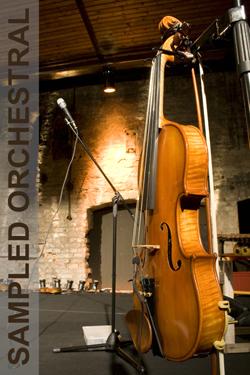
A sampled orchestra is a close imitation of a real one, or rather, the special-purpose recording and triggered playback of the sounds of individual orchestral instruments (or section of instruments). The playback of the sounds is accomplished by a new musical performance on a keyboard or with another type of midi- or non-standard digital controller. The way the samples are made ready for a composer’s use – the sound sourcing process – is fairly simple and standard:
First, high-quality recordings of individual notes played by various instruments are made, one by one across their entire musical range, capturing each note performed with different expressions and techniques, possibly using different microphone setups and even various spaces (concert hall, performance stage, studio, etc.).
Secondly, the combination of the hundreds of recorded samples are organized in a digital sample player (hardware or software) in order for the appropriate notes (samples) to be played back when striking the keys across a keyboard (or other midi controller) with various strength. For instance, when one hits a middle C softly on the controller keyboard, the “soft middle C piano” sample (a short recording of the instrument’s softly played middle C note) will be played back by the sampler, sounding until the key is held. Once the key is released, the “middle C string soft damping with hammer action noise” sample is played back, imitating the noise of the real piano key’s release. The keys of the controller keyboard act like playback start buttons, each triggering the playback of the appropriate combination of recordings.
The performance can be quite convincing, especially to the untrained ears. The majority of the orchestral scores of movies and tv films made in the past 10-12 years were produced with this technique. The goal is to create an orchestral recording, which gives the impression of a real orchestra’s performance – without the logistic challenges and serious expense of hiring an orchestra, support staff, renting a sound stage or concert hall, etc. Sample libraries produced by several companies who specialize in sample-set production can be purchased – you can put together an imitation orchestra sample library for as little as $500 (or for serious professional work for as much as $50,000). However, the challenge isn’t so much in achieving a great sound quality (today’s samples are usually pretty high quality recordings), but in making the performance believable.
With sampled orchestral setups, the challenge isn’t in achieving a great sound quality but in making the performance believable.
The character and expressive playability of real instruments come in large part from their design – the way they are designedto be played. In general, we know not only the sound character of an instrument, in case of a violin, the timbre of the violin, but we know the sound of the violin when played by a violinist. After we transfer the various sound samples into a sampler, we will be playing every instrument using a keyboard. Without a bow, without strings, and without the techniques acquired and perfected by years of violin practice, we will not be able to use the pure sound of a violin with the same expression as a violin player can.
Of course, technology tries to have an answer for everything – in this case mostly by imitation of reality (though never a perfect copy – which would defeat the purpose anyway). Sample manipulation, software programming and audio mixing tricks, as well as the use of various performance controllers on keyboards (buttons, levers, pots, sliders, ribbons, etc.) can add more life and expression to the sound by changing certain characters of it (i.e. the more important parameters of the samples). Moreover, some less traditional midi controllers have emerged in the past decade, with the promise of a more varied, sometimes more natural performance communication between the player and the sample playback device or software. While some of them are played by blowing and striking, other controllers use buttons, digitally cnotrolled valves, touch-pads and laser, infrared or ultrasonic beams. Although with all these controllers we can add a wide range of expressions to the sound, or smoothly switch from one playing technique / sample to another during the performance, something is missing. It is the organic, human touch what makes a real performance come alive; the imperfections, noises, and the fact that on real instruments, the same notes never sound the exact same, and they rarely sound perfect.
A popular technique called sweetening is often used to help this issue; by adding a few real musicians’ performance on real instruments to the mix of the digitally-created orchestral parts, imperfections, noises and subtle variations in performance can be introduced. The intention is to “humanize” the piece and mask the overly polished sound of the sampled orchestra at the same time. Although this masking doesn’t make ones and zeros become organic material, the difference between a real orchestral performance and a well-produced sampled orchestra can be unrecognizable by most listeners. (Some exceptionally well-produced compositions can give a hard time even to professional composers and orchestrators when trying to guess whether they are listening to sampled & sweetened or an entirely orchestral performance).
Sampled orchestras tend to work better for large symphonic pieces, than for solos and chamber setups, where the digital nature of the sampler performance is harder to hide. Of course, knowing the attributes and limitations of all traditional instruments, their performance techniques and tricks, as well as being experienced at orchestral work is a major advantage for composers who venture into performing sampled orchestral music. Naively, some feel like an instant “orchestral composer” by simply playing a keyboard and switching between various orchestral samples. The affordability and convenience of technology has falsely empowered many, often only to result in embarrassingly fake-sounding recordings (even in “professional circles” – let’s not mention the A-list examples here).
Sounds of the electro-orchestral music
Since electro-orchestral music isn’t really orchestral music as far as the instruments concerned, we approach it with a healthy absence of preconceived notions or expectations. In the above example of the violin, we all know what this traditional instrument sounds like, what sound to expect to come out of it. But, we usually don’t know what an electronic musical instrument sounds like before we hear it. Synthesizers and other electronic instruments sound the way we make them sound. Not only there is no “perfect sound” to match, nor centuries-old standards and performance techniques to imitate, often, the more original or unique character they produce, the better. As the phrase “electro-orchestral” suggests, the music is usually composed on and produced with electronic instruments, and the sound itself is electronic in nature… but then what makes electro-orchestral orchestral?
If a piece of music sounds “kind of like orchestral” but it’s not, the chances are it was simply poorly produced; it might be trying to sound like orchestral, but the quality of samples, or more often, the sub-standard performance gives it away. Many who don’t have the access to high quality samples or the knowledge and experience to write orchestral music for an orchestra, make the mistake of trying to sound like one, using a common rompler plugin, cheap samples or a digital synth or workstation. It is not what electro-orchestral music is.
Electro-orchestral music is one that sounds “almost like an orchestral piece” because of the overall grand feel of the sonic experience and the structure/arrangement of the music, but it does not intend to sound like an orchestra at all. The various sections of an orchestra, like strings, brass, woodwinds, percussion, can be represented by electronic sounds with similar general character to their related orchestral instruments/sections, but with no intention to imitate the traditional orchestra’s sound. Their place in the overall sonic palette of the music and their role in the arrangement and orchestration (electro-orchestration would be a better phrase) can be very similar, however. For example a violin-like sound playing a melody line in the higher octaves, a bright brass-like sound playing a mid-range melody or stabs that the horns would play in an orchestra, or a flue-like sound playing a counter-melody or small micro-melodies in the style of a typical woodwinds section. However, these sounds are not created by traditional instruments nor by their samples, but by various electronic components found in hardware instruments such as synthesizers, or by software algorithms.
Sounds created by electronic instruments can introduce the new element of sonic texture to the musical environment, a dimension relatively limited in pure orchestral music. This new element can strongly influences the feel the music carries or creates, and ultimately effects the entire ideology behind the composition and the compositional process.
In addition, sounds not even remotely reminiscent of traditional instruments can be used, often adding important flavors to the electro-orchestral piece. An arpeggiated bass, a randomly changing lfo-d filter, a glitch-y percussion part, a sweeping pad, an ethnic instrument’s lead or some manipulated environmental noise can complement the more standard parts of the orchestration structure well. In a sampled orchestral piece, they might work against the goal of imitating an acoustic instrumentation, but in electro-orchestral music, they can add original character, a unique feel and expression to the piece. At the end, a deliberately electronic instrumentation, giving the overall feel (but not the sound) of an orchestral-size performance will carry the composer’s message to the listener.
Differences beyond technicalities
The type and purpose of music that the composer desires to create determines the approach, tools and techniques (s)he uses to achieve the best results. For example, to score an emotional cue in a romantic movie, a composer might use real strings, woodwinds and piano, but without the budget (mostly the case) or time to record live players, a good alternative is to imitate them by a sampled-orchestral performance. This also gives the composer the flexibility to easily re-write and re-arrange parts later. The goal is still to sound as close to the real soaring strings of an orchestra as possible.
A completely different purpose and style might inspire the composer to turn to the electro-orchestral approach. Sounds created by electronic instruments can introduce the new element of sonic textureto the musical environment, a dimension relatively limited in pure orchestral (real or sampled) music. This new element can strongly influence the feel the music carries or creates, and ultimately effect the entire idea behind the composition and the compositional process. An example of this would be a score for a futuristic movie, that requires the music cues typically used in such movies (action, romance, surprise, mystique, etc.) to support the plot and characters, however, carries the futuristic environment in every bit of the sound. Think of Blade Runner – an orchestral score could have worked fine, but the electro-orchestral approach doubled the impact and unique feel of the movie. While sounding somewhat traditional, the score was entirely produced with synthesizers.
(A challenge for composers: let’s switch up the instrumentation and genre of the last two examples. Writing an orchestral score for a sci-fi movie is the easy part – can be done routinely, has been done many times. But, how would you approach scoring a real-life story’s romantic scene with electronic instruments? This forces you to think about sounds, textures… go beyond the traditional musical elements of rhythm, melody and harmony, and ultimately create something more original.)
While movie scores are the most representative examples, the same is true for musical works. We often don’t realize that the reason behind the largish feel and “full”, “well-though-out” and “complete” sound of a track is its orchestral-like arrangement- and instrumentation structure, but it being performed with non-traditional sounds doesn’t make the similarity obvious. This is even true for many mainstream songs today. It is interesting to note, that some typical sounds and sound categories of early (and actually, even many of today’s) synthesizers are named mirroring their orchestral “inspirations”; some of the most known (and now classic) synth patches are the likes of “Jupiter-6 strings”, “CS-80 brass” or “DX-7 piano”. Although at more than one point in the history of electronic music (see “Ambient vs. New-Age”) these instruments did try to imitate their real counterparts, they remained far-from perfect impressions of them, but with a unique character of their own, responsible for great success of some excellent non-orchestral composers. (They eventually became classic electronic sounds themselves, subject of imitation and sampling by newer electronic instruments and software – more about this later in another post, until then listen to some famous sounds here).
Tradition and Progression
Personally, I have a great respect for the traditional instruments of the symphonic orchestra, and have used them quite a lot (from large real orchestras to cutting-edge sampled orchestral setups). But I have an even bigger appreciation for the electronic instruments; when using them, we don’t imitate, rather create sounds (and even new imaginative instruments). We create more than just a melody, a theme, a piece, a mood, we create a feel that even a single note can carry! Why limit ourselves to the 35-40 traditional orchestral instruments when writing music with grandiose feel or for expressive instrument solos, if we can have the luxury of using thousands of traditional and non-traditional ethnic instruments (or their samples) and an unlimited number of electronic sounds as well?
I believe that the electro-orchestral (and various electronic, ambient, etc.) music opens up the boundaries and greatly expands the limits of the (otherwise fairly versatile) traditional instruments. It must have been super exciting to first explore these possibilities in the 60’s and 70’s with the first synthesizers, however with today’s music technology industry on one side, and the challenge to create truly original sounds and new musical instruments on the other side, it is still a never-ending adventure. Many of us have first-time memories of a feel or a sonic experience created by some non-traditional sounds in a movie, a film trailer, or even just a song on the radio. And while some of yours might be electronic in nature, it’s interesting to realize that their role in the music might have been the same as a traditional instruments role in the most known classical pieces a few hundred years ago.
Same structure or not, the new dimension of sonic textures might just be what gives us the amazing feeling of discovering new musical landscapes today.