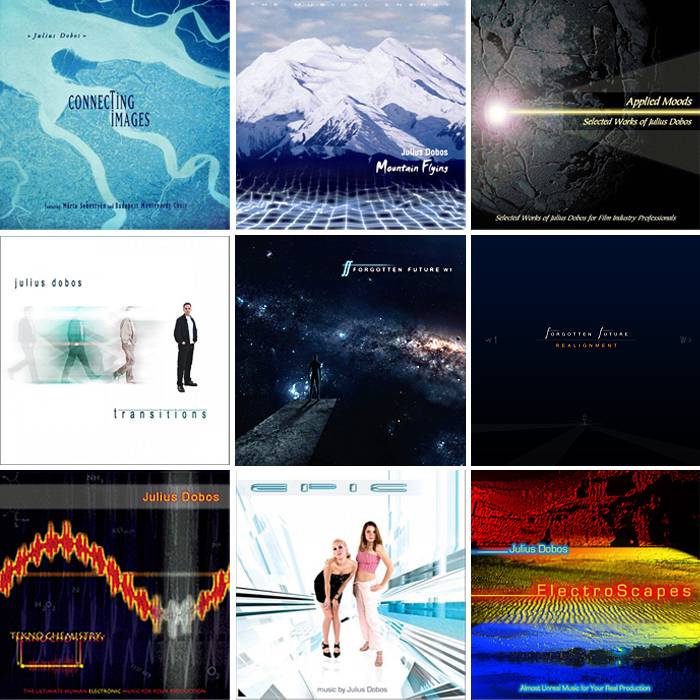
Creative Shop Music has announced the planned release of remastered, expanded editions of a range of Julius Dobos’ albums. The new series of releases will include the platinum album Connecting Images, the now-classic Mountain Flying, and Epic, among others. Aside from an improved sonic experience, fans can expect to find previously unreleased bonus tracks on some of the remastered editions. The new digital-only album releases are scheduled for 2022.
Did the covid pandemic help to produce more or better, fresher music?
Since the 2020 onset of the pandemic, I had to change aspects of my lifestyle and many plans — like most everyone else. Although my 2020/21 music performances had to be canceled and I even moved my lectures online, I’ve had the opportunity to catch up on giving talks, interview and join panels during the past couple of years. The topics ranged from music production, sound synthesis, performance technology to the culture of music and sound, fan events, directions in film scoring and even representing my anti-AI principles at a prestigious audio panel for the Audio Engineering Society.
It’s great to talk at industry events and panels, but what I enjoy about “prosumer” audiences, up and coming music people, is their non-pretentious huger for knowledge and creatively interesting questions. A topic I spoke about for a small and intimate audience at the Silicon Valley Music Production Summit last year is a good example of how to avoid the same old formula questions and talk about some fresh ideas, uncensored by cultural expectations. Its high point was my compositional justification for considering a recent pop tune “better music” than one of Mozart’s well-known works.
Unlike the rest of the music-making community, I did not use the unexpectedly available home-bound time to “write a song a day”. I did not jump on fb/IG to offer music production workshops to the masses, even though, suddenly every other human with no real production experience became a “music producer” in 2020… Nor did I purchase production gear to upgrade my studio to “perfect my sound” during the downtime – apparently, everyone else did, as Sweetwater closed a year of record profits. I didn’t even finish my long-long due forgotten future: W2 album.
What I did instead was the opposite: I listened. let me explain.
“I had nothinig else to do under the lockdown, so I made tracks… lots of new tracks! I got many clicks so now I’m teaching other producers how to produce music… lots of it!”
Do we really need a few million new tracks every day?
It’s great that people now have very affordable tools to create music – the process should be certainly available for all to enjoy. But distributing all the “tracks” that most anyone now who knows how to use a computer can “produce” overnight, might not be what humanity needs. See, the problem is not the quantity, but the quality of the great majority of that huge quantity. Placing technology first and music second unsurprisingly results in very similar output from a diverse range of people, which usually lack authenticity and originality. I consider production mainly as packaging for musical ideas. Starting with the packaging (and even doing that mainly by copying the “experts” of packaging) will unlikely allow for injecting great content into the finished package after the fact. And, you know what tons of empty packaging is… trash. To me, this is a simple equation: quality and quantity are diametrically opposed concepts.
Lots of good music takes time
On top of the quantity issue, some things just take time; no pandemic can force us, at at least not directly, to be more productive at the same quality standards. I’m not questioning the production quality of a high-output “producer” (although with continuous production, dilution is bound to happen). Nor am I suggesting that good work has to take years. What I am suggesting is a balance between absorbing and expressing, like a good conversation. There must be some kind of emotional input in order for us to create an emotional output. The input can be a feeling, an event, a situation, whatever effects us. The output is what we express in our own voice, whether that be through music, painting or another art form. Processing too many emotions too quickly may simply not allow us to fully and deeply absorb them. Similarly, we can’t expect ourselves to create interesting content if we don’t have enough emotional input to begin with. Forcing this natural process of absorption-expression for the sake of higher productivity will inevitably produce more but shallower art.
I for sure would not be opposed to hearing fewer new releases but fresher, more original music. I well remember attending a platinum producers’ panel at a major audio convention. After talking about the old vs new in music production techniques for an hour, one of the more seasoned producers ended the panel with the rhetorical question: “But where is the music today!?”.
That was in 2012. Now, ten years later, the question is more relevant than ever.
Miura is sadly gone, but Berserk’s Guts is back – courtesy of Studio Taka. Live action Bersek film in pre-production.
Berserk Motion Comic Episode 3 ((Studio Taka)
Kentaro Miura’s name is synonymous with Berserk, a manga-based universe that has seen several adaptations. These have included novels, various animated films and even some video games. Reportedly, a live-action Berserk is under pre-production for HBO now. Fans have been long unhappy with the translation to screen as animations simplified the story and altered the manga’s original feel. The unfaithful execution of the 2016-2017 tv-series (along with its low animation quality) especially left followers disappointed.
Picking Up Berserk – with a Deserving Theme
Studio Taka, a fan-based studio with an international crew, has picked up the story and has been creating the Berserk motion comic in a uniquely cinematic style. Fans are finally getting the authentic storytelling and artful execution they have wished for for decades. By Episode 3, the creators felt the need for Guts (Berserk’s main, complex, twisted character) to receive his own musical theme. They turned to Julius Dobos for Guts’ Theme, which he composed in the Fall of 2021 and produced just in time for Episode 3’s release at the end of the year. One of the four variations of Guts’ Theme, titled Guts Quiet Rage, was used in the trailer of Berserk Episode 3, while the upcoming episodes will feature the theme’s other versions, including the bombastic Guts’ Epic Fight. (You can listen to Guts’ Epic Fight on the sidebar of this page.)
Watch the Behind-the-Scenes mini documentary on YouTube and download Guts’ Themes on Bandcamp. All proceeds go to Action Against Hunger, who combat hunger worldwide, including the war-ravaged areas of Ukraine.
Two years ago, already being fed up with the then-16 year long trend of everyone re-releasing classic analog synths, I predicted a new trend of digital hardware machines, and in particular, the return of wavetable synthesis, as the next phase of idea-recycling. It is now reality.
Synthesis revival in the 21st Century: New Analogs
In 2002, Robert Moog released the Moog Voyager, a recreation of his famous original, the Minimoog (Model D). It was, and is, a fantastic instrument, which did more than just bringing back the classic sound with a familiar layout: it added more oscillator stability, more performance control, more convenience and more instantaneous feedback for the player. What most don’t realize is that it was the Voyager that started a revival of analog synths, which I call “new analogs”, on a larger scale, turning the electronic music instrument industry upside down (or rather, downside up), ultimately undeniably effecting the culture of electronic music.
Bob Moog was working out of passion. Whether the timing of the Voyager release was a proper celebration of him reclaiming his company’s name and kicking off a new era of Moog Music, or it was responding to a rapidly growing need for true analog sound, it had a profound effect on the electronic musical instrument industry. Why transition back to analog from the late ’90s-early 2000s super-capable and convenient VA (virtual analog) gear? On one hand, the retro aesthetic started coming back in areas outside of music: fashion, dance, photography. The sounds of virtual analogs were fat, warm, diverse, however very precise and therefore not retro in any way. Bands started using classic analog synths – even bringing them on the stage. Releases with the ’80s retro aesthetic, but offering a new and original sound (such as Ladytron’s 604, to mention one of the most brilliant albums) got the attention of electronic music fans and producers alike. Unstable, dirty-sounding leads and basses starting to become cool again, at least in various local scenes, primarily in the UK and in some parts of Europe. At the same time, used prices of vintage synths have already reached questionably reasonable levels on eBay – it has become a dream (and a perceived way to reach originality) for many to own a vintage MS-20, Model D or Prophet 5.
While Moog wasn’t the first one to release a new analog (for example, Studio Electronics has never stopped since the early ’90s), the visibility and prestige of the Moog name signaled to other brands: new analog is the best of both words: it is real, stable and convenient. Some were fast to follow, some already had products that the Voyager justified putting more promotion behind. Some lagged and took a decade to come out with new analog models. Brand new companies were launched exclusively making new analog synthesizers.
Synthesizers of the 2010’s: New Analogs in New Markets
Fast-forward a decade. Electronic music steps out of the underground in the United States; EDM is suddenly on mainstream platforms and on the charts, everyone wants to incorporate the electronic sound. Manufacturers and distributors are happy: a brand new market opens up for them, in the land of hobby musicians with disposable income, where technology is cheap, “money buys creativity” is a rarely-questioned belief, and where the role of tech in culture is high: the United States.
Around the middle of the decade, mainstream bands proudly use analog synths again, the dubstep phase passes by – fortunately relatively quickly, like a nightmare that screams “modern electronic music equals aggressive sounds (and who cares about harmony)”. After the pixel-dust of un-musicality settles, day-dreaming Gen X musicians (not in small part thank to Vaporwave) bring back the sound of the ’80s. First it’s cool, and then, as it usually happens with anything that can be sold based on nostalgia to two generations, it becomes commonplace; television shows promote the retro aesthetic: synthwave takes off. The music instrument industry is now ecstatic: modular synths are on the rise, instrument product catalogs now offer more new analog synths than ever before in history (and actually more analogs than digital synths). Why? Because “real synthwave is supposed to be real analog” – so they say. So naturally, everybody needs a 303 synth – and not just any synth, but an analog one! Because they are “better than anything digital” (so are the newcomers told). Musical sound design becomes a must-do for anyone who wants to be taken even semi-seriously; using preset sounds starts to become a sin in the electronic music scene (not surprisingly also in the US, where getting lost in the technical wizardry typically wins over emotional content anyway, and in this rare case, it wins even over convenience).
So what’s wrong with this picture? It’s a trend, driven by technology and instrument marketing, celebrating the idea of re-production of the familiar past, rather than by originality and the celebration of creation (except for the modular world, where, for the most part, the truly original and truly unlistenable stuff happens). Ironically, despite of the overly technology-focused approach, almost all analogs use subtractive synthesis!It’s not hard to put the two together: one of the most limited synthesis methods is now heavily influencing where electronic music is going in 2010, after 70 years of history! And, America being the very best when it comes to exporting anything that’s well wrapped in trends, the changes spread worldwide. But who cares, manufacturers are flooding the new markets with old recipes in shiny packages (even drawing the respect of self-nominated “synth fans”).
New Wave of the 2020s – Wavetable Synths
During the second half of 2010s, astonishingly boring re-releases of classics and degenerated clones of clones promise new sonic worlds, while in reality, they rarely add a feature or two to Robert Moog’s 1968 concept. Manufacturers are making a killing with re-releases – until Behringer enters the game and spells death to an era, with shameless brand-stealing, unoriginal recreations and plastic heaven.
Thinking about it, maybe I should like Behringer after all. With their business model now they are unknowingly forcing the rest of the industry (which is unable to compete with such low prices) to move onto new trends. In 2018 I said: “analog has been the new cool thing in electronic music production for all too long now; this drawn-out phase of telling sheep users [referring to the mass mentality of easy-to-influence tech-focused buyers] that analog is the “best” will be soon replaced by digital, again; probably wavetables”. I doubted that any influential player in the industry would dare to release products with a new type of synthesis, but bringing back a short but often-praised era of wavetables seemed like an easy to promote contrast, therefore a less risky option. Just by looking at the used price trends of PPGs, Waldorf (Micro)waves, Wavestations and Fizmos, and the relatively short attention that they enjoyed while romplers and VAs took over, one could see how the desire for something lesser known was bound to create a new trend. It took the industry two years to do it – with the usual exception of pioneering Waldorf, who not only moved fast with the Quantum, but had a great advantage in wavetable design to begin with.
Wavetables, Wavescanning – Already Dripping from Popularity
Wavetables have always been with us, integrated into digital synths like the Virus TI and plugins NI Massive, Serum and more recently Arturia’s Pigments. Some companies ventured into augmenting their analog synths with a wavetable osc option like DSI’s Prophet 3 with its scannable wavetable source, or adding wavetables as an extension to their software packages, like Ableton 10’s Wavetable plugin. (Again, kudos to Arturia for jumping ahead of the trends with no history in wavetables, but instead of copying Waldorf, giving birth to an original concept, the Microfreak). In the months before the 2020 NAMM Show, no less than five companies suddenly introduced their dedicated wavetable synths to the masses: Modal’s Argon8, Softube’s Parallels, Udo’s Super 6, the ASM Hydrasynth, and of course, Korg’s Wavestate. Why do we need to recycle old sound synthesis concepts? Actually, why do we need trends in instrument design at all?
Will manufacturers and distributors try to convince everyone now that wavetable synthesis is the best? Will they market them with the “most unique” and “most flexible” message? They already kind of do. But, who cares. Talking with Brian Transeau (aka BT, who actually well understands the power of inner ideas) yesterday I got the impression that almost noone seems to mind the fact that manufacturers are dictating the trends now, and thus, heavily influencing the styles and trends in (electronic) music. I, for one, do mind. Even as a sound synthesist who’s been preaching about the importance of sound design for 25 years, I wish true creativity that originates from new experiences and unique concepts would primarily influence music, and synth players would use whatever technology as a tool of expression once again, not the other way around. What BT and I agreed on was that those of us who want to express ideas free from industry trends, will always find the tools to convey such ideas with authenticity. Just like we always did when we needed them, regardless of the trends in technology. But it’s not so easy to ignore the heavy marketing and influence of trendy new instrument design by those who are new to electronic music.
So, dear fans of electronic music: get ready for the new wave of wavetables, and with that, a lot of wavetable music hits. Korg has done its part to add easy-to-impress presets in the Wavestate (I bet Dr. Luke pre-ordered it or has already put them into a dozen of mainstream pop songs), but come on, Roland, Moog, Yamaha – add those Wavetable OSC buttons quickly… before NI blankets the world with a PPG library and Behringer makes a $199 Prophet VS clone! Then you all have to recycle something else and tell us what’s the new cool in music. (Additive synths in 2024, anyone?)
A quick summary of my personal impressions of the new wavetable gear:
ASM Hydrasynth: amazing control and expression, easy to set up modulation… I almost bought one. But the more I heard it, the more fake it sounded. That plastic-y, predictable, trying-too-hard-to-impress, too-perfect, too-shiney over-packaged character turned me off and left me quite disappointed.
Modal Argon8: beautifully designed instrument with smooth and rich sound, but not a whole lot of extremes, a held-back character that promises a relatively limited sonic world with not many surprises to explore. I wish it could get more raw, more real.
Korg Wavestate: an impressive and capable preset-machine with so much happening in its sound, that it can be easily a turn-off. It sounds fun since a lot of movement, loops, performances are “printed” into the waveform or use the sequencer: too easy to get sidetracked and more inspiring to play than to create with. Sound designers with tons of time to initialize patches might take its sound elsewhere, but since it’s going to be the most commercially successful synth of 2020 (mark my words!), Wavestate sounds will be showing up in productions all over the world – which is exactly why I’d never want one.
Waldorf Quantum: this is the only one here I personally have not tried yet. What I heard sounded worthy of the Waldorf name, though, even if a bit too silky. I’m personally turned off by the touch-screen display; give me more buttons with direct access to parameters instead.
Final verdict: pick up a Prophet VS or a Microwave for rawness and flexibility.
forgotten future live at SIGGRAPH 2019 in Los Angeles – featuring the first ever real-time audience-controlled music performance of its kind
Following a successful 2017 show, Julius is returning to SIGGRAPH this year with a newly composed official Theme Music, and to perform the theme at the Opening Ceremony in Los Angeles, California. The majestic, electronic – symphonic score will be also heard throughout the conference (and around the downtown L.A. Convention Center). You can play & download an mp3 file of the music here.
SIGGRAPH is the world’s largest, most influential annual conference and exhibition in computer graphics and interactive techniques, attended by tens of thousands of professionals in the areas of film, games, VR and other new visual media.
FORGOTTEN FUTURE – INTERACTIVE AUDIENCE-CONTROLLED MUSIC at SIGGRAPH
Julius as forgotten future will be also performing a 25-minute set at Real Time Live! on Tuesday, July 30th at the Los Angeles Convention Center. This revolutionary, experimental music event will reverse the roles of performer and audience, and put the control over Julius’ performance into the audience’s hands – quite literally. Various aspects of the music will be collectively influenced by several different sections of the audience in the 2,500 auditorium – in real-time. Julius will “gently guide” the audience through spontaneous projection of motion graphics, while participants will be using their smart phones to collectively change various aspects of the music and sound.
The event will be the first interactive performance of its kind in the word, and will also include a section where the audience will be composing a completely new piece of music together with Julius in real time. This will be achieved by sensors capturing smart phones’ flashlight gestures in several areas of the auditorium, computers translating those impulses into messages that are then fed into Julius’ performance computer and electronic musical instruments on stage. The set will feature three popular forgotten future tracks and an electronic, trance-inspired version of the new SIGGRAPH Theme.
In order to attend the performance (and witness the latest in computer graphics and interactive technologies), you must have at least a one-day ticket to the Real Time Live! event. The SIGGRAPH website gives you plenty of options to choose from.