I configured my Dolby Atmos Renderer for 11.1.10 playback at Stanford CCRMA in preparation for my talk later this year. You too can go beyond the 9.1.6 configuration (which most everyone assumes the Renderer is maxed out at) – you can actually push it to 11.1.10.
Industry standard meets ultra-custom immersive audio setup
The dichotomy of academic research focus and industry standardization is almost amusing to explore. Have you ever walked into a prestigious academic research institution where experimentation is everything, and felt like uttering an industry-standard format is blasphemy? And vice versa, have you felt way too nerdy to bring up your experiments in highly-customized systems (that would never fly in the commercial world) at an industry event? If you answered yes to either, you know what I mean.
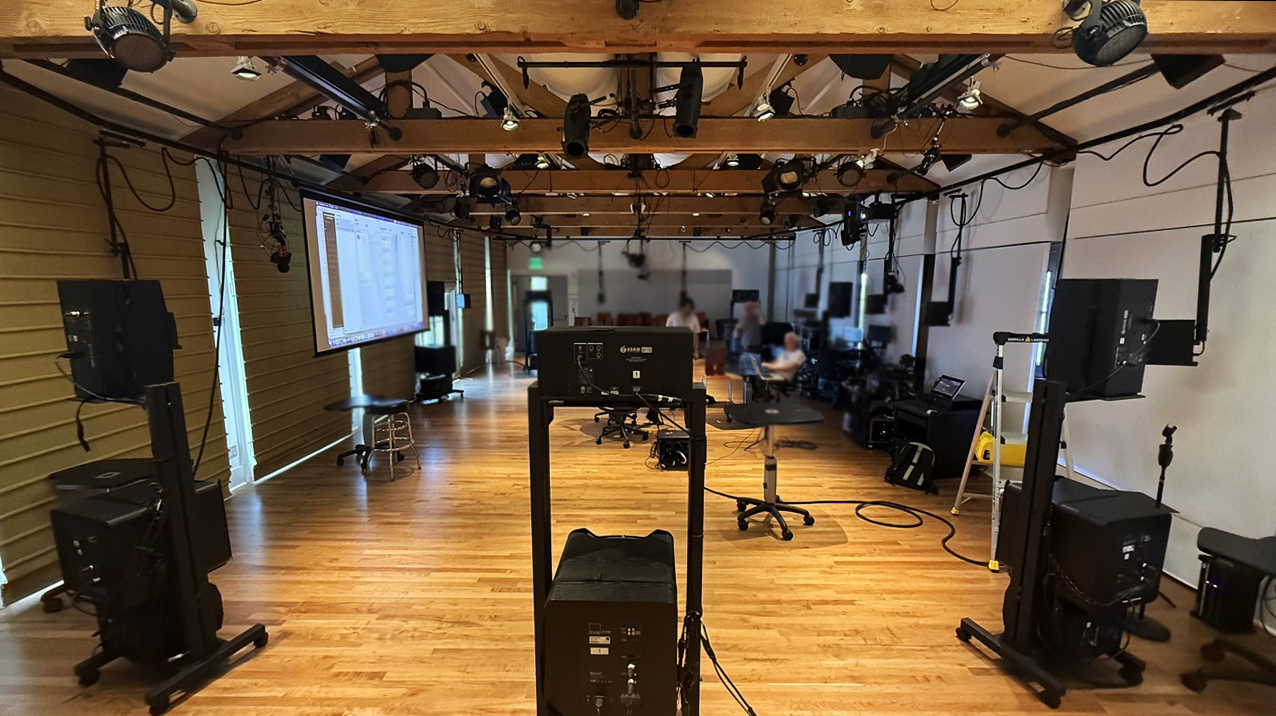
11.1.10 Dolby Atmos speaker configuration at Stanford CCRMA – from front to back view. In preparation for my Spatial Composition talk. Photo by Franck Martin.
Navigating between these two professional environments requires respect, understanding, tact, translation (sometimes literally) – and a “why not!?” attitude. But if you navigate them with success, the results may give you the best of both words: experimental yet practically applicable.
When I configured my standard Dolby Atmos Renderer for 11.1.10 immersive playback at Stanford CCRMA in preparation for my talk later this year, I knew it wasn’t a “first” by any means. Yet, it sent minor shock waves through the community of immersive audio professionals in LinkedIn. As it was received with a mix of surprise and doubt, I will detail the setup below.
Production and Playback in Dolby Atmos: Why Stop at 7.1.4 or 9.1.6?
The CCRMA Stage offers 56 discreet channels (64 monitors) in a highly flexible arrangement – but doesn’t follow any standard formats, like Atmos (for good reasons, mainly freedom in research). Contrary to popular belief, you can go beyond 9.1.6 monitoring through the standard Dolby Atmos Renderer.
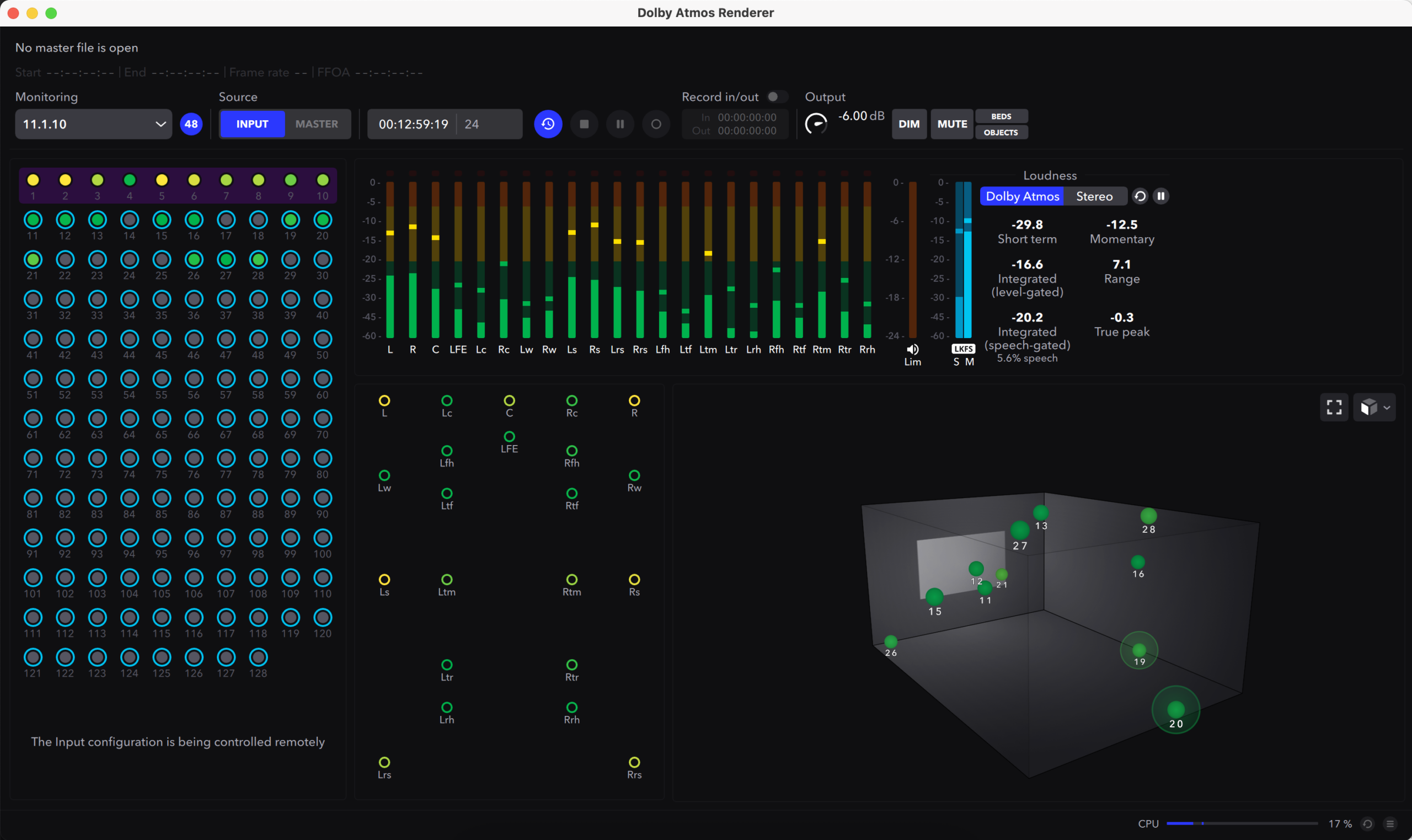
11.1.10 Dolby Atmos speaker configuration for my Spatial Composition talk with 22 discreet channels.
Thank to several ABV-networked interfaces, the wonderful colleagues at CCRMA and I were able to configure 22 discreet channels for a quite detailed Atmos playback. As of this writing, we are thinking about adding 12 more monitors to reach the 34 limit of the (non-cinema) renderer in array mode. (More about the pros and cons of this here).
Myths vs Actual Capabilities
Just like most colleagues, I also thought up until a few days ago that Dolby’s “normal” (not Cinema) Renderer only supported up to 9.1.6 discrete channels and up to 35 speaker outputs in array mode – and then still capping discreet outputs at 9.1.6.. This is false. Yes, 9.1.6 is a standard channel configuration, but “standard” does not mean “maximum”. This week at CCRMA we set up and tested 11.1.10 in the Dolby Atmos Renderer without using any arrays, only utilizing discreet outputs – i.e. not achieving extra spatial locations with proximation or “phantom sides”, but proper 11.1.10 playback. The Renderer allows this as long as the audio interface (or networked interfaces) are allowing it. (CCRMA’s Stage is using 6 MOTU M8s networked via AVB). While in my presentations at various Dolby Cinemas I had the luxury of using the Cinema Renderer, for this configuration we used the “regular” Renderer that we all know. (The Cinema version provides expanded channel count, however, it is only available for theatrical installations.)
You Can Use 22 Discrete Channels Right Now
Go to your Dolby Atmos Renderer’s Room Setup and enable all speakers (without turning on non-array mode). You might be surprised to see that the distribution of speakers on the interface is front-heavy with those extra addressable channels. I believe this is meant for top high-end home cinema playback, i.e. film sound.
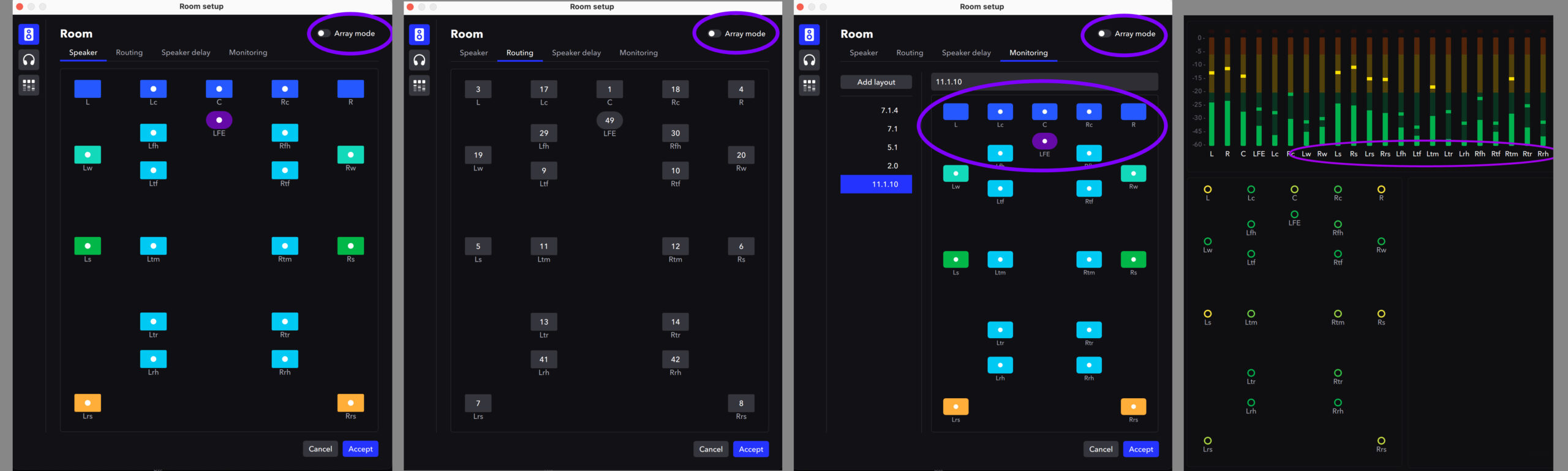
11.1.10 Dolby Atmos Renderer maximum speaker configuration for Spatial Composition at 22 discreet channels. Note the non-array mode, the discreet output channels per speaker, the output name abbreviations, and the clustering of speakers in the front – necessitating the physical re-arrangement / re-calibration of speakers (otherwise the front area is too dense for music playback). Our playback tests confirmed the discreet playback to each speaker as shown in the renderer configuration here.
It can make sense for music, though, in two instances:
• if you are using it throughout your composition and production phases and take advantage of a more detailed stage up front. It also gives you increased spatial resolution in the overhead channels. It translates perfectly to other 11.0.10 or higher systems, and should play back well in 7.1.4 and 9.1.6 as well. Just have to remember to compensate with the higher sum of energy in the front cluster.
• if you can intentionally reconfigure the whole room for an evenly-spaced arrangement, i.e. repurposing those extra FR channels and adjusting your physical setup accordingly (also re-calibrating it). This is the way to go if you don’t care about translation to other systems, i.e. you are composing for a specific site (e.g. music and sound installations).
We went for the 2nd option and somewhat rearranged the playback space. For this reason, the Renderer’s UI shows the theatrical 11.1.10 configuration, but the physical arrangement of speakers looks a bit different. In the future, I will likely compose a piece with the first use case of 11.1.10 in mind.
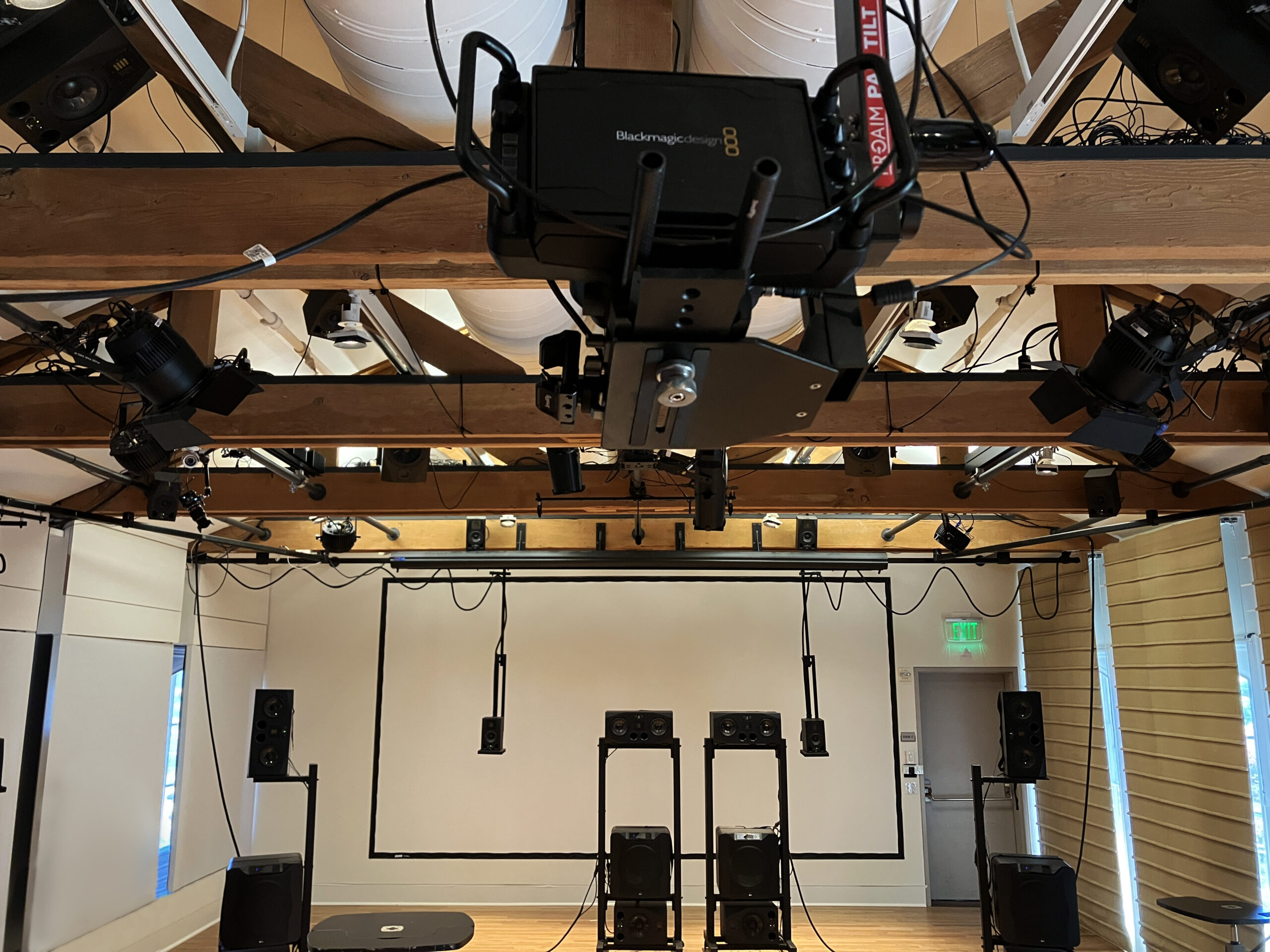
11.1.10 Atmos configuration at Stanford CCRMA – front stage and front height channels view. In preparation for my Spatial Composition presentation.
In Summary
I am not the first one to make this configuration happen by any means – others have done it with very expensive home theater receivers and AVB network switches. What this experiment taught me is that custom high-end systems can allow us to ignore some standard practices and push the capabilities of the software to its actual limits.
My talk at Stanford CCRMA will be on November 4, 2026. Until then, some more testing is planned – and I will update this page with new documentation and audio+video.