
Tl;dr – it’s quite easy for anyone to get into spatial composition that reaches the audience today. While other formats are also available, Dolby Atmos covers the full pipeline from synthesis and composition all the way to distribution and playback. It yields the power to express and absorb original musical ideas, using space as the 5th element of music. This immersive music guide explains, that in order to get into spatial music,
• Creators only need a DAW that integrates Atmos (free in Pro Tools, Logic, etc.)
• Listeners don’t need anything more than what they are already using to listen to music (even just a pair of regular headphones)
• Professionals wanting to go beyond the 9.1.6 configuration (which most assume Atmos is maxed out at) can actually push it to 11.1.10 (see Part 2).
Spatial Composition – a Short Summary
(to jump to the practical section, click here)
Since the completion of my Spatial Composition research, I have been focused on developing related new techniques, refining aesthetics, and demonstrating its potentials at various spaces around the country – including at Dolby’s own three screening rooms (currently the only three in the world) in San Francisco, Hollywood and New York City.
As I’m planning to take the concept on an international tour, today I have stopped to reflect on how (relatively) easy the road has been to get here – although it was a long journey that started around 1994. What started it was the impressive, now-famous Dolby Train trailer. It was screened before movies for several years in movie theaters. It’s a long story of mine that I tell in my talks, involving the first surround sound-equipped movie theater back in Budapest (Sport mozi), a projectionist, some wine and my emotional reaction to sound (barely music) moving in space. I always saw space – space as in spatial location and movement – as a synthesis parameter. The problem was that no way to control it in a usable, sharable form existed up until 7-8 years ago.
(One notable surround synthesis exception one might think of is the Hartman Neuron synthesizer from 2001; it had spatial joysticks and 5.1 outputs, it was compact, far more user-friendly than software environments like Max/MSP, but also rare, expensive, under-supported… and after all, most surround music created stopped after the production stage before reaching distribution, as there was no feasible path to take surround compositions to consumers to experience its spatial design). While I had the concept of spatial synthesis and composition in mind for a quarter of a century, I wasn’t able to express it for my audience.
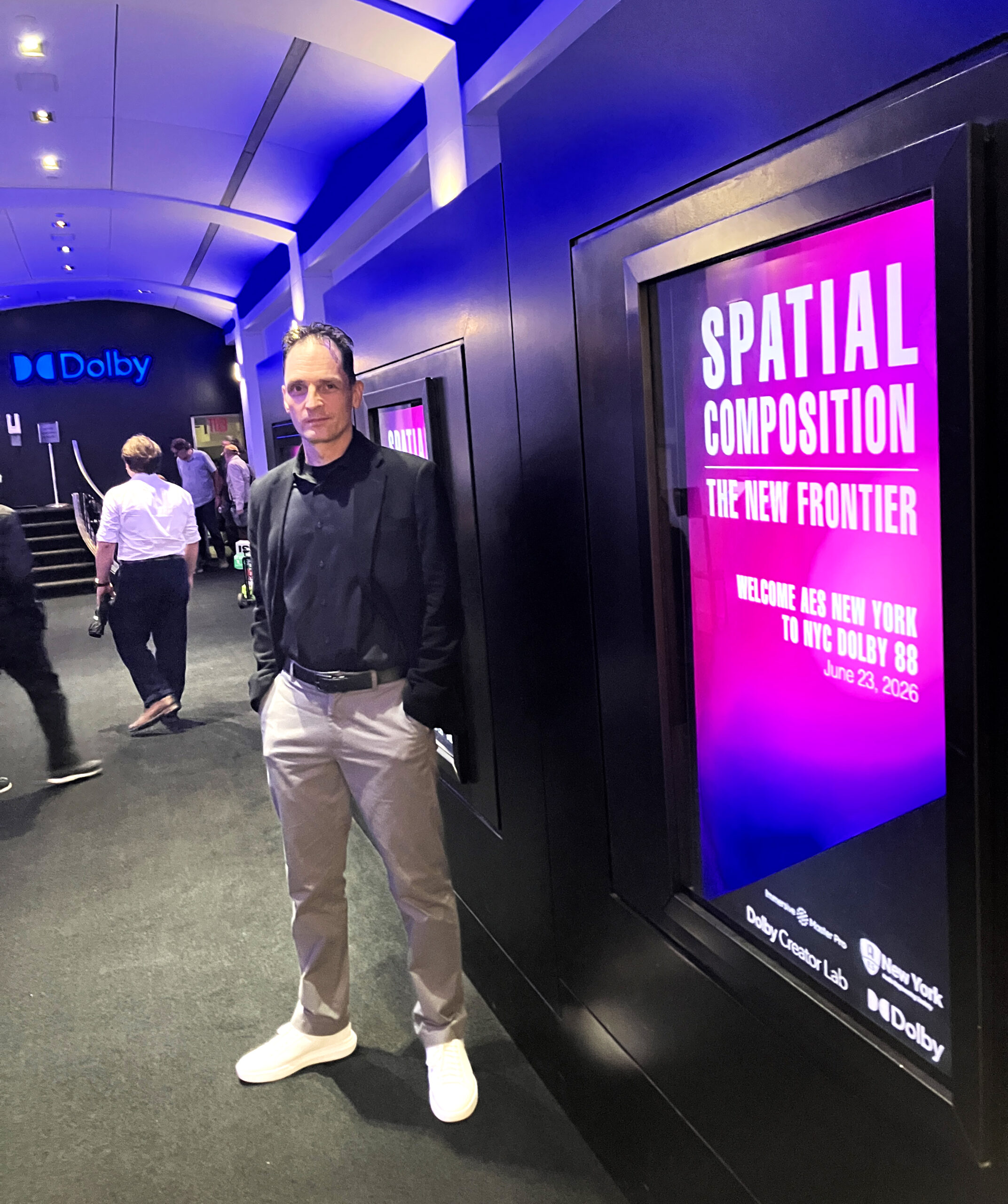
At Dolby’s New York City screening room before by Spatial Composition talk
Accessible Immersive Music Tools
Jumping forward by a few decades, I got re-energized by the possibility to compose in- and for Atmos – way before it was done by anyone (it still isn’t really), while I was mixing the forgotten future W1 album in Atmos (which was the newest thing to do) back in 2019. Sitting in a studio at Dolby HQ, I had realized how much the meaning of textures and melodies changed depending on their location and movement in the 360-degree dome space. This is when I set out to shift my focus from mixing in space or arranging for space to using location as a core, conceptual part of composition, not an afterthought during the execution of such concepts.
Aside from the delays caused by the covid lockdown, the journey has been quite smooth. The tools weren’t as user-friendly in 2019 as they are now, but fortunately Atmos was created with the user, not the researcher in mind. So, if you really wanted to figure it out, you certainly could. It doesn’t take more to get into Atmos or other immersive formats today than it takes for someone to learn a new DAW (of course, knowing a DAW first is expected). The power of the tool – and the ecosystem that it opens up for immersive music – is no joke. So much so, that the data from my research led me to think of (and subsequently publicly promote) SPACE as the 5th element of MUSIC (joining rhythm, melody, harmony and timbre).
This is big. Maybe almost as big as music concrete was 75 years ago (which eventually birthed electronic music). Of course, this isn’t a new invention: I’m merely picking up the true concept of spatial composition where Varèse left it off; I’m objectively testing, pushing the boundaries of the concept and applying it in practical, accessible ways using today’s new technologies and ecosystems.
For Creators: a New Way to Create Original Content
This section assumes that you are already familiar with the basic concept of object-based spatial audio. If not yet, head here first.
Why do it?
Instead of trying to race against the ever-expanding camp of amateur and professional songwriters, lyricists, composers, musical experimenters on their quest to craft an original message using the traditional elements, you might want to add an entirely new category of expressive ingredient to your writing. (Not to mention racing against ai, which recycles the traditional elements of music in new combinations – but would never think of going outside of sounds, lyrics, melodies, rhythms and harmonies.) Adding the 5th element, space, to your writing (not just production!) process opens up a whole new dimension (pun intended) in the expression of emotions and thoughts through music. This is not something that can be recycled or machine-learned, since the number of historical precedents of the conceptual use of spatial movement in music is close to none.
What do you need?
Only a DAW that already includes the Dolby Atmos Renderer. Currently, Pro Tools, Logic, Cubase, Nuendo do this natively. For users of other DAWs, you can get the standalone Dolby Atmos Renderer to connect with your DAW. (If you’re not using any DAW just an instrument or paper & pencil, talk to your engineer 0 see below).
This solution will give you up to 11.1.10 channels and 34 speakers for composing. How many have so many speakers, you might ask. The good news is that you have a binaural option, that is, working in your regular headphones and getting the impression that your sounds, musical elements surround you. Binaural render algorithms have been getting really good, too. While the binaural experience (which the Atmos Renderer also provides) isn’t the same as the physical experience of 34 speakers around you, remember that the concept behind spatial composition is all about original expression, not production. And, in my experience, binaural monitoring can take you into that 5th dimension 80% of the way as you are conceptualizing and writing your composition.
How about Engineers?
Aside from the basic technical know-how, the main skill you need in order to mix spatial compositions is communication. That is, listening to the creator, understanding and accepting their vision, their spatial concept. If they composed in- and for space in a DAW, take their spatial automation (export from their DAW into yours). Can they only describe their concept? Listen and take notes, then apply it to the mix. If the author doesn’t have a concept at all, take the opportunity to co-create one with them. (Side note: in my research I put down a solid logic as to why engineers should get writer’s co-ownership for co-creating spatial content – another discussion for another time).
For Listeners: How to Experience Immersive Music?
Why should you care?
Because it can be more expressive in ways that you haven’t experienced before. Also because it can enable your favorite composers, songwriters to create original content that otherwise they would not think of creating.
Isn’t immersive music just a gimmick?
Well, this is where the difference between a spatially composed piece, a smart immersive mix and an average spatial mix differ in big ways. A mixing engineer working in Atmos (or Sony 360 or Eclipsa or ambisonics or in any of the other formats for that matter) has the option to move musical elements around the space as they wish – even randomly. They have the option to move instruments around to their own taste, but do so without following any concept (defined together with the creator or solely by the the creator of the piece) will be amiss. This approach may weaken the original concept (if there was one) – and an acoustic guitar or a shaker flying all over in space for no apparent reason can definitely feel gimmicky. And very often it does and becomes nothing more than a senseless showcasing of what technology can do.
But, following the concept of the author during production can help express and even strengthen their concept. A good spatial production materializes and locks in the emotions via space, that the composer initially felt during the conception phase. This is how an immersive mix can reach its potential and provide a stronger, aesthetically far more cohesive experience for the listener – exactly the way the composer intended to convey them.
What do you need?
Similarly to creators, you have a couple of options: lots of speakers or headphones. You don’t have to know which music file to choose: streamers recognize what system you are using and select the correct format for you ((e.g. the spatial audio version for an Apple TV or the binaural version for your headphones). Tune into Apple Music or Tidal (make sure that your subscription covers this feature and that the track you select is actually available in Atmos), and you’re off to listening to immersive music. Well, at least impressively-sounding audio. True spatial composition? That;s much less likely, as there is hardly any available, so far, but it’s coming.
Until then, a few music recommendations, in growing order of proximity to true spatial composition:
Dave Grusin: West Side Story (1997) – surround arrangement and mix
Jean-Michel Jarre: Aero (2004) – surround re-mix / 3 tracks of surround concept
Robert Rich: Nest (2012) – surround concept and mix
Peter Gregson: Patina (2021) – spatial concept / arrangement and immersive recording, mix
Justin Gray: Immersed (2025) – spatial concept / arrangement and immersive recording, mix
Isao Tomita: (1976/1991 release) – spatial synthesis and re-composition (adaptation of Holst)
forgotten future: Circular Time (2023) – spatial synthesis
Julius Dobos: Spatial composition research (2025) – spatial composition and mix
Edgard Varèse: Poème Électronique (1958!) – spatial composition and performance
(unfortunately only approximate recreations are available)