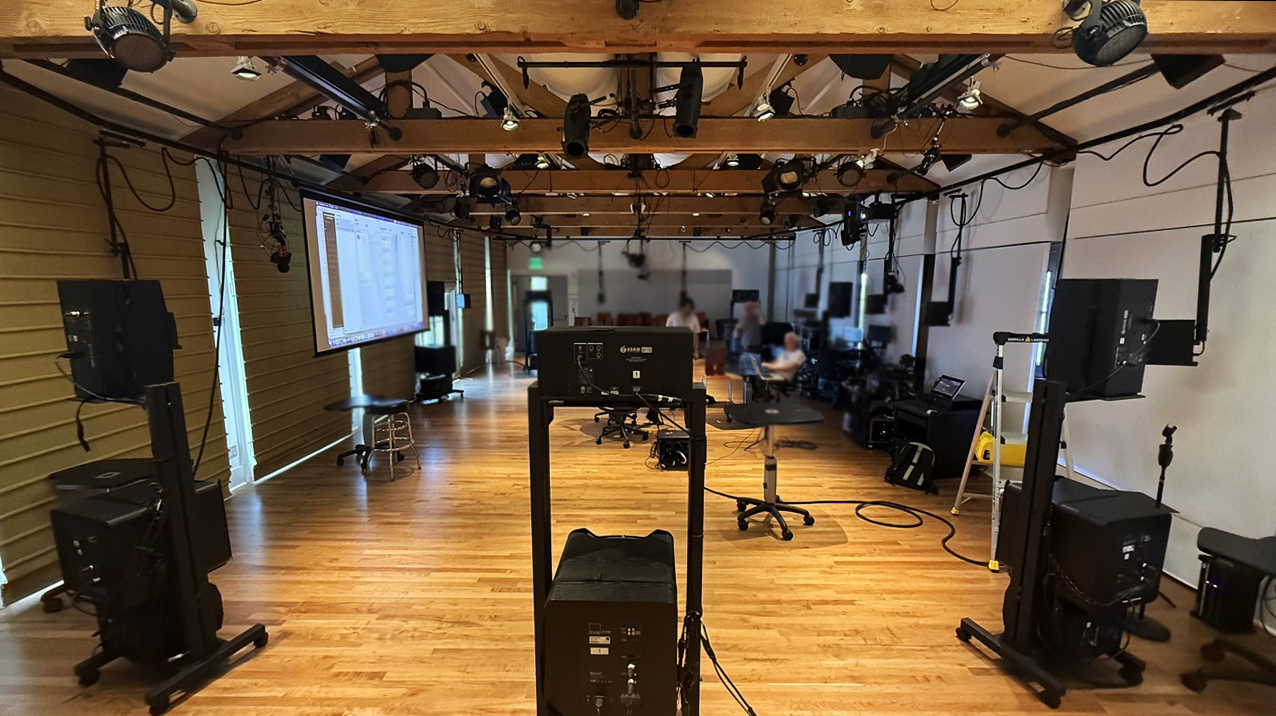
I configured my Dolby Atmos Renderer for 11.1.10 playback at Stanford CCRMA in preparation for my talk later this year. You too can go beyond the 9.1.6 configuration (which most everyone assumes the Renderer is maxed out at) – you can actually push it to 11.1.10.
Industry standard meets ultra-custom immersive audio setup
The dichotomy of academic research focus and industry standardization is almost amusing to explore. Have you ever walked into a prestigious academic research institution where experimentation is everything, and felt like uttering an industry-standard format is blasphemy? And vice versa, have you felt way too nerdy to bring up your experiments in highly-customized systems (that would never fly in the commercial world) at an industry event? If you answered yes to either, you know what I mean.
11.1.10 Dolby Atmos speaker configuration at Stanford CCRMA – from front to back view. In preparation for my Spatial Composition talk. Photo by Franck Martin.
Navigating between these two professional environments requires respect, understanding, tact, translation (sometimes literally) – and a “why not!?” attitude. But if you navigate them with success, the results may give you the best of both words: experimental yet practically applicable.
When I configured my standard Dolby Atmos Renderer for 11.1.10 immersive playback at Stanford CCRMA in preparation for my talk later this year, I knew it wasn’t a “first” by any means. Yet, it sent minor shock waves through the community of immersive audio professionals in LinkedIn. As it was received with a mix of surprise and doubt, I will detail the setup below.
Production and Playback in Dolby Atmos: Why Stop at 7.1.4 or 9.1.6?
The CCRMA Stage offers 56 discreet channels (64 monitors) in a highly flexible arrangement – but doesn’t follow any standard formats, like Atmos (for good reasons, mainly freedom in research). Contrary to popular belief, you can go beyond 9.1.6 monitoring through the standard Dolby Atmos Renderer.
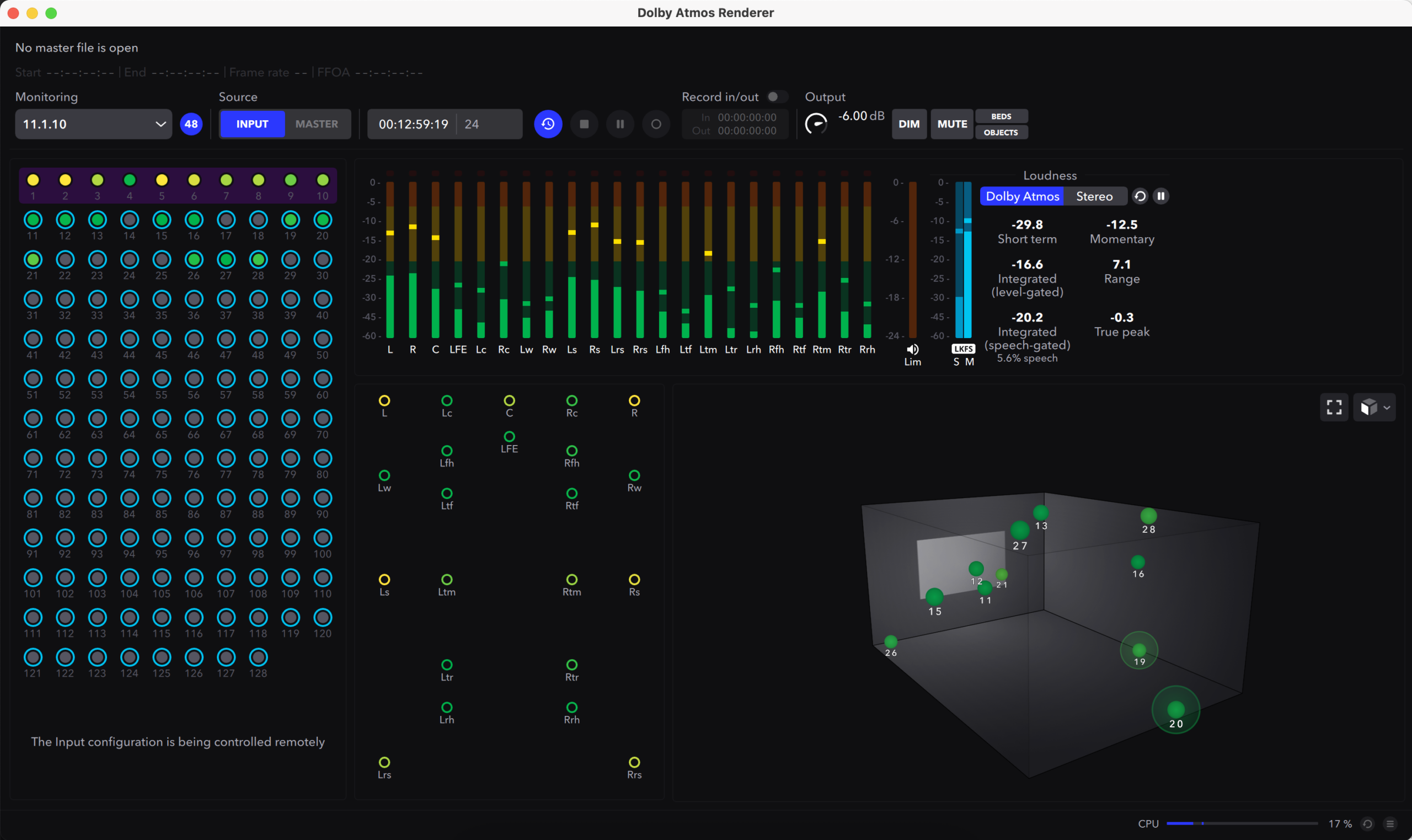
11.1.10 Dolby Atmos speaker configuration for my Spatial Composition talk with 22 discreet channels.
Thank to several ABV-networked interfaces, the wonderful colleagues at CCRMA and I were able to configure 22 discreet channels for a quite detailed Atmos playback. As of this writing, we are thinking about adding 12 more monitors to reach the 34 limit of the (non-cinema) renderer in array mode. (More about the pros and cons of this here).
Myths vs Actual Capabilities
Just like most colleagues, I also thought up until a few days ago that Dolby’s “normal” (not Cinema) Renderer only supported up to 9.1.6 discrete channels and up to 35 speaker outputs in array mode – and then still capping discreet outputs at 9.1.6.. This is false. Yes, 9.1.6 is a standard channel configuration, but “standard” does not mean “maximum”. This week at CCRMA we set up and tested 11.1.10 in the Dolby Atmos Renderer without using any arrays, only utilizing discreet outputs – i.e. not achieving extra spatial locations with proximation or “phantom sides”, but proper 11.1.10 playback. The Renderer allows this as long as the audio interface (or networked interfaces) are allowing it. (CCRMA’s Stage is using 6 MOTU M8s networked via AVB). While in my presentations at various Dolby Cinemas I had the luxury of using the Cinema Renderer, for this configuration we used the “regular” Renderer that we all know. (The Cinema version provides expanded channel count, however, it is only available for theatrical installations.)
You Can Use 22 Discrete Channels Right Now
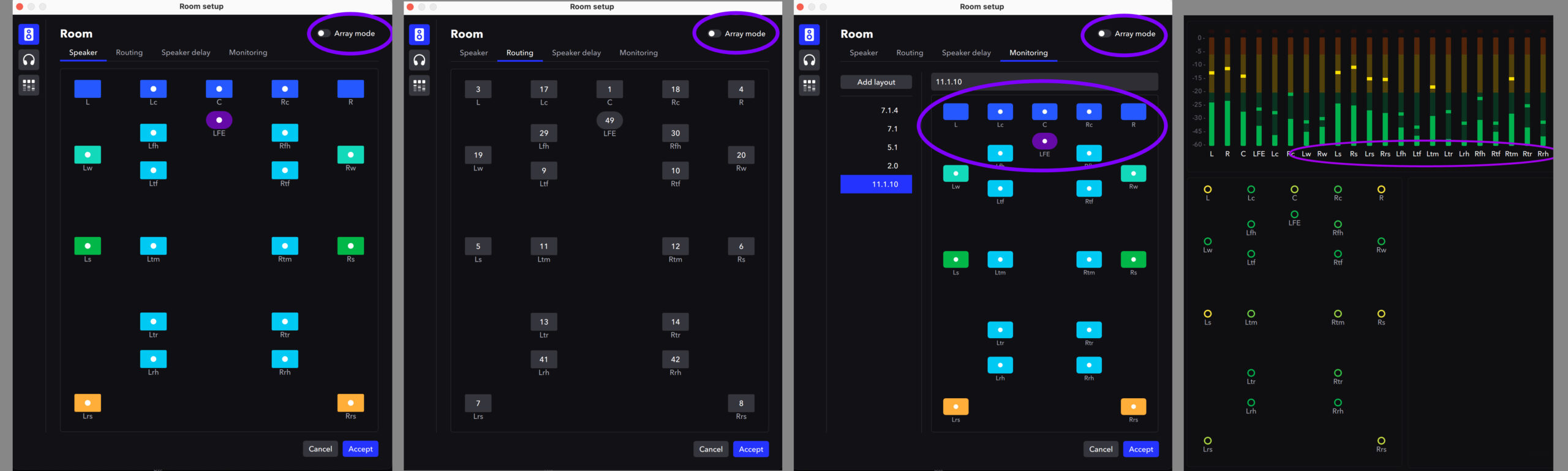
Go to your Dolby Atmos Renderer’s Room Setup and enable all speakers (without turning on non-array mode). You might be surprised to see that the distribution of speakers on the interface is front-heavy with those extra addressable channels. I believe this is meant for top high-end home cinema playback, i.e. film sound.
11.1.10 Dolby Atmos Renderer maximum speaker configuration for Spatial Composition at 22 discreet channels. Note the non-array mode, the discreet output channels per speaker, the output name abbreviations, and the clustering of speakers in the front – necessitating the physical re-arrangement / re-calibration of speakers (otherwise the front area is too dense for music playback). Our playback tests confirmed the discreet playback to each speaker as shown in the renderer configuration here.
It can make sense for music, though, in two instances:
• if you are using it throughout your composition and production phases and take advantage of a more detailed stage up front. It also gives you increased spatial resolution in the overhead channels. It translates perfectly to other 11.0.10 or higher systems, and should play back well in 7.1.4 and 9.1.6 as well. Just have to remember to compensate with the higher sum of energy in the front cluster.
• if you can intentionally reconfigure the whole room for an evenly-spaced arrangement, i.e. repurposing those extra FR channels and adjusting your physical setup accordingly (also re-calibrating it). This is the way to go if you don’t care about translation to other systems, i.e. you are composing for a specific site (e.g. music and sound installations).
We went for the 2nd option and somewhat rearranged the playback space. For this reason, the Renderer’s UI shows the theatrical 11.1.10 configuration, but the physical arrangement of speakers looks a bit different. In the future, I will likely compose a piece with the first use case of 11.1.10 in mind.
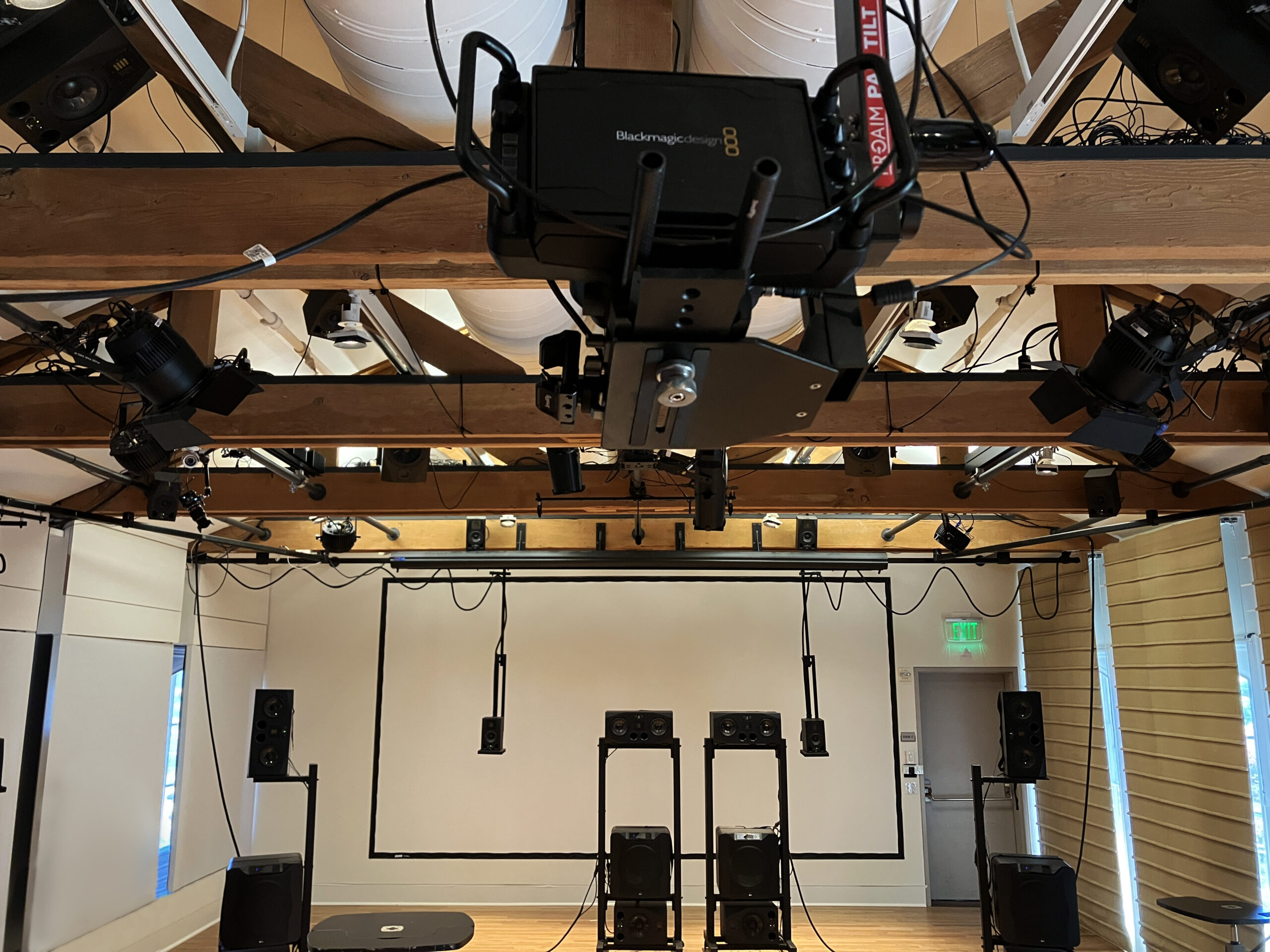
11.1.10 Atmos configuration at Stanford CCRMA – front stage and front height channels view. In preparation for my Spatial Composition presentation.
In Summary
I am not the first one to make this configuration happen by any means – others have done it with very expensive home theater receivers and AVB network switches. What this experiment taught me is that custom high-end systems can allow us to ignore some standard practices and push the capabilities of the software to its actual limits.
My talk at Stanford CCRMA will be on November 4, 2026. Until then, some more testing is planned – and I will update this page with new documentation and audio+video.
Tl;dr – it’s quite easy for anyone to get into spatial composition that reaches the audience today. While other formats are also available, Dolby Atmos covers the full pipeline from synthesis and composition all the way to distribution and playback. It yields the power to express and absorb original musical ideas, using space as the 5th element of music. This immersive music guide explains, that in order to get into spatial music,
• Creators only need a DAW that integrates Atmos (free in Pro Tools, Logic, etc.)
• Listeners don’t need anything more than what they are already using to listen to music (even just a pair of regular headphones)
• Professionals wanting to go beyond the 9.1.6 configuration (which most assume Atmos is maxed out at) can actually push it to 11.1.10 (see Part 2).
Since the completion of my Spatial Composition research, I have been focused on developing related new techniques, refining aesthetics, and demonstrating its potentials at various spaces around the country – including at Dolby’s own three screening rooms (currently the only three in the world) in San Francisco, Hollywood and New York City.
As I’m planning to take the concept on an international tour, today I have stopped to reflect on how (relatively) easy the road has been to get here – although it was a long journey that started around 1994. What started it was the impressive, now-famous Dolby Train trailer. It was screened before movies for several years in movie theaters. It’s a long story of mine that I tell in my talks, involving the first surround sound-equipped movie theater back in Budapest (Sport mozi), a projectionist, some wine and my emotional reaction to sound (barely music) moving in space. I always saw space – space as in spatial location and movement – as a synthesis parameter. The problem was that no way to control it in a usable, sharable form existed up until 7-8 years ago.
(One notable surround synthesis exception one might think of is the Hartman Neuron synthesizer from 2001; it had spatial joysticks and 5.1 outputs, it was compact, far more user-friendly than software environments like Max/MSP, but also rare, expensive, under-supported… and after all, most surround music created stopped after the production stage before reaching distribution, as there was no feasible path to take surround compositions to consumers to experience its spatial design). While I had the concept of spatial synthesis and composition in mind for a quarter of a century, I wasn’t able to express it for my audience.
At Dolby’s New York City screening room before by Spatial Composition talk
Accessible Immersive Music Tools
Jumping forward by a few decades, I got re-energized by the possibility to compose in- and for Atmos – way before it was done by anyone (it still isn’t really), while I was mixing the forgotten future W1 album in Atmos (which was the newest thing to do) back in 2019. Sitting in a studio at Dolby HQ, I had realized how much the meaning of textures and melodies changed depending on their location and movement in the 360-degree dome space. This is when I set out to shift my focus from mixing in space or arranging for space to using location as a core, conceptual part of composition, not an afterthought during the execution of such concepts.
Aside from the delays caused by the covid lockdown, the journey has been quite smooth. The tools weren’t as user-friendly in 2019 as they are now, but fortunately Atmos was created with the user, not the researcher in mind. So, if you really wanted to figure it out, you certainly could. It doesn’t take more to get into Atmos or other immersive formats today than it takes for someone to learn a new DAW (of course, knowing a DAW first is expected). The power of the tool – and the ecosystem that it opens up for immersive music – is no joke. So much so, that the data from my research led me to think of (and subsequently publicly promote) SPACE as the 5th element of MUSIC (joining rhythm, melody, harmony and timbre).
This is big. Maybe almost as big as music concrete was 75 years ago (which eventually birthed electronic music). Of course, this isn’t a new invention: I’m merely picking up the true concept of spatial composition where Varèse left it off; I’m objectively testing, pushing the boundaries of the concept and applying it in practical, accessible ways using today’s new technologies and ecosystems.
For Creators: a New Way to Create Original Content
This section assumes that you are already familiar with the basic concept of object-based spatial audio. If not yet, head here first.
Why do it?
Instead of trying to race against the ever-expanding camp of amateur and professional songwriters, lyricists, composers, musical experimenters on their quest to craft an original message using the traditional elements, you might want to add an entirely new category of expressive ingredient to your writing. (Not to mention racing against ai, which recycles the traditional elements of music in new combinations – but would never think of going outside of sounds, lyrics, melodies, rhythms and harmonies.) Adding the 5th element, space, to your writing (not just production!) process opens up a whole new dimension (pun intended) in the expression of emotions and thoughts through music. This is not something that can be recycled or machine-learned, since the number of historical precedents of the conceptual use of spatial movement in music is close to none.
What do you need?
Only a DAW that already includes the Dolby Atmos Renderer. Currently, Pro Tools, Logic, Cubase, Nuendo do this natively. For users of other DAWs, you can get the standalone Dolby Atmos Renderer to connect with your DAW. (If you’re not using any DAW just an instrument or paper & pencil, talk to your engineer 0 see below).
This solution will give you up to 11.1.10 channels and 34 speakers for composing. How many have so many speakers, you might ask. The good news is that you have a binaural option, that is, working in your regular headphones and getting the impression that your sounds, musical elements surround you. Binaural render algorithms have been getting really good, too. While the binaural experience (which the Atmos Renderer also provides) isn’t the same as the physical experience of 34 speakers around you, remember that the concept behind spatial composition is all about original expression, not production. And, in my experience, binaural monitoring can take you into that 5th dimension 80% of the way as you are conceptualizing and writing your composition.
How about Engineers?
Aside from the basic technical know-how, the main skill you need in order to mix spatial compositions is communication. That is, listening to the creator, understanding and accepting their vision, their spatial concept. If they composed in- and for space in a DAW, take their spatial automation (export from their DAW into yours). Can they only describe their concept? Listen and take notes, then apply it to the mix. If the author doesn’t have a concept at all, take the opportunity to co-create one with them. (Side note: in my research I put down a solid logic as to why engineers should get writer’s co-ownership for co-creating spatial content – another discussion for another time).
For Listeners: How to Experience Immersive Music?
Why should you care?
Because it can be more expressive in ways that you haven’t experienced before. Also because it can enable your favorite composers, songwriters to create original content that otherwise they would not think of creating.
Isn’t immersive music just a gimmick?
Well, this is where the difference between a spatially composed piece, a smart immersive mix and an average spatial mix differ in big ways. A mixing engineer working in Atmos (or Sony 360 or Eclipsa or ambisonics or in any of the other formats for that matter) has the option to move musical elements around the space as they wish – even randomly. They have the option to move instruments around to their own taste, but do so without following any concept (defined together with the creator or solely by the the creator of the piece) will be amiss. This approach may weaken the original concept (if there was one) – and an acoustic guitar or a shaker flying all over in space for no apparent reason can definitely feel gimmicky. And very often it does and becomes nothing more than a senseless showcasing of what technology can do.
But, following the concept of the author during production can help express and even strengthen their concept. A good spatial production materializes and locks in the emotions via space, that the composer initially felt during the conception phase. This is how an immersive mix can reach its potential and provide a stronger, aesthetically far more cohesive experience for the listener – exactly the way the composer intended to convey them.
What do you need?
Similarly to creators, you have a couple of options: lots of speakers or headphones. You don’t have to know which music file to choose: streamers recognize what system you are using and select the correct format for you ((e.g. the spatial audio version for an Apple TV or the binaural version for your headphones). Tune into Apple Music or Tidal (make sure that your subscription covers this feature and that the track you select is actually available in Atmos), and you’re off to listening to immersive music. Well, at least impressively-sounding audio. True spatial composition? That;s much less likely, as there is hardly any available, so far, but it’s coming.
Until then, a few music recommendations, in growing order of proximity to true spatial composition:
Dave Grusin: West Side Story (1997) – surround arrangement and mix
Jean-Michel Jarre: Aero (2004) – surround re-mix / 3 tracks of surround concept
Robert Rich: Nest (2012) – surround concept and mix
Peter Gregson: Patina (2021) – spatial concept / arrangement and immersive recording, mix
Justin Gray: Immersed (2025) – spatial concept / arrangement and immersive recording, mix
Isao Tomita: (1976/1991 release) – spatial synthesis and re-composition (adaptation of Holst)
forgotten future: Circular Time (2023) – spatial synthesis
Julius Dobos: Spatial composition research (2025) – spatial composition and mix
Edgard Varèse: Poème Électronique (1958!) – spatial composition and performance
(unfortunately only approximate recreations are available)
Spatial Composition is not an entirely new concept; from Varèse’ Poème Électronique, Isao Tomia’s The Planets to the immersive music we experience at museum exhibits today, the element of space (location and movement of sounds) have been explored during the past 75 years. And of course, many music streamers are familiar with the Dolby Atmos mixes that have been at the top of popular music charts over the past couple of years.
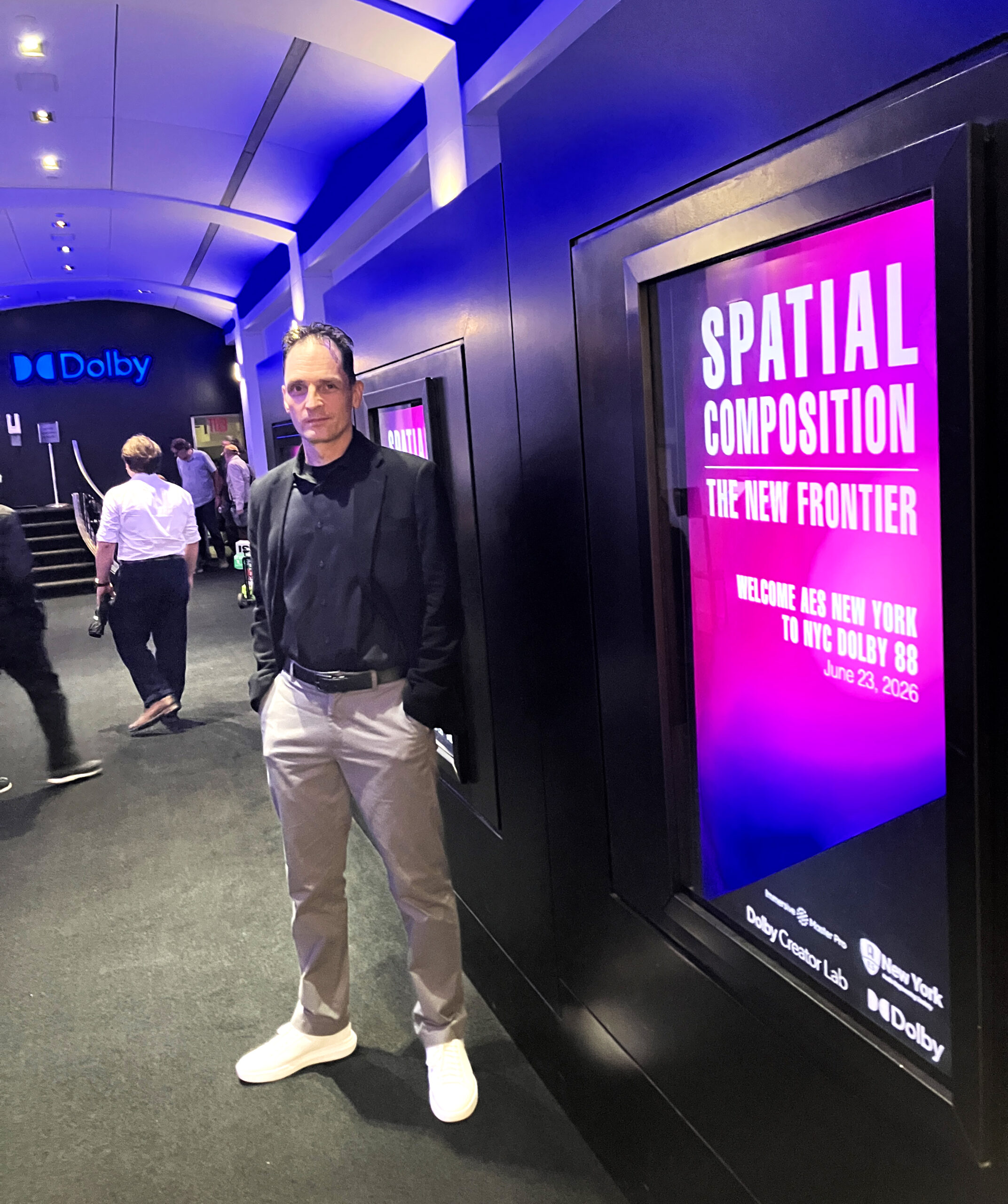
Spatial Composition – The New Frontier poster. Research presentation event at Dolby Headquarters for the Audio Engineering Society and the Recording Academy.
Expanding the established elements of music composition (melody, harmony and rhythm), musique concrète brought us timbre – often cited as the 4th element of music – 75 years ago. Through decades of struggle for acceptance, it took a fundamental role in the development of electronic music. Are we at verge of the next musical disruption? Can space become the 5th element of composition?
New research by Julius Dobos reveals that the spatial element is more powerful than just a listening format. The use of space as a compositional tool during the composition process has the power to influence melody, harmony, rhythm and timbre, thus impacting the meaning and emotions of the music itself. Supported by data from his two research experiments and over 200 focus groups listeners, this realization inspired Julius to apply spatial synthesis and spatial composition techniques to several new works. As part of his presentation for the Audio Engineering Society and the Recording Academy, guests will experience the use of space in these immersive compositions in Dolby Atmos at Dolby Lab‘s San Francisco Headquarters on October 9.
If you can’t make it to the premier event at Dolby on October 9th, come to hear Julius’ talk at the AES Long Beach Convention on October 24th. Here you can also read the Spatial Composition research summary and paper.
I get a fair amount of questions from the students in my UEMP (Ultimate Electronic Music Production) course each year. Often these are questions about specific genres or production approaches or synths. This Fall, though, I got some bigger-picture ones, so why not share a couple of the answers here.
Q: “Would it be possible to create another branch on the tree [of origins of electronic music] in our modern world of electronic music?”
A: Technically and in theory everything is possible. Practically, quite difficult; it’s difficult to not be fundamentally influenced by what we already know. I believe a completely new, thick branch (directly growing out of the double-trunk of the Electronic Music Tree rooted in France and Germany) will / can only be grown by a non-musician artist, from another discipline, like painting, sculpture, dance or poetry. One could argue that Schaeffer, Stockhausen, etc. made significant progress thank to their not-purely-musical interests. The less someone is exposed to music, the more likely they won’t be influenced by the genres already out there (any existing “branches”), especially the 1950s-70s roots, and can think artistically but freely. The only time the origins of an entirely new direction in electronic music was not tied to the 70s andwas a musical in its source (Jamaica), was Jungle (then Drum & Bass) in the early ’90s. The unrelated components being in the right time and place and actually cross-influencing one another – such coincidental cultural collaborations are uncommon in today’s too-multinational world. Though, maybe we could still give a Model D and a zoom recorder to the indigenous tribes of the Amazon who live far away from modern civilizations, collaborate with them and see what comes out of it…
At the same time, a new smaller branch (a branch growing out of a large branch of the tree) might come from a musically-oriented (trained or not) person in a different musical environment (possibly not even electronic music). Again, the less they know about electronic music, the less likely they will be effected by what has existed before them, thus, the more likely they will create something uninfluenced by existing electronic music. Still, it’s likely that we will be able to trance the results back to one of the main trunks of the tree (i.e. GRM, BBC, JMJ, Kraftwek, Vangelis, Tomita, Eno, etc.).
Like I often say in the beginning of UEMP semesters: the technology to create something groundbreaking and originalintentionally break has been in front of us, for many years. Powerful computers and more free plugins that one could explore in a lifetime are now in our pockets. Affordable technology to write the music of the future is reality, even for the average college student. But you have to fight the part of your DNA that always makes you create music similarly to the way you normally create and listen. Producing Musique concrète has the ability to take you very far from all that… listen to your Musique concrète work a half year later and you might be surprised by what you had created. An inspiring point to start from.
Q: “If Kraftwerk hadn’t popped when they did, how do you think things would have turned out for electronic music?”
– and – Q: If Kraftwerk had never existed, where do you think electronic music would be today? Would it be at a previous point on the electronic music timeline or would it have gone in a completely different direction?
A: Well, I’m not that old to have been there… I was a small kid playing the piano in the 80s when Kraftwerk had been already around for a decade and well-known in Europe… so their influence on most everything-in-4/4 in electronic music was a done deal by then. But I’ll take a stab at hypothesizing about this fascinating proposition.
It is truly interesting to think about what would have happened to electronic music if Krafwerk’s Autobahn wouldn’t have received much attention, or hadn’t even been released… or if Ralf und Florian wouldn’t have met or even existed. Well, let’s break this down based on the components that Kraftwerk combined into a pioneering new direction in electronic music:
The 4/4 time signature would have become popular in electronic music in some fashion anyway, since it was the middle ages’ 2/4 folk dance rhythms then the ’60s disco’s straightforward patterns that evolved into 4/4 dance-able rhythms – the point being dance-able – in other genres as well.
Sequenced, quantized basslines and arps would have been sooner or later migrated from Jarre’s and Schultze’s kitchen to other, more rhythm-based genres. Kraftwerk was inspired by the persistent, “quantized” action of mechanical machines, but certainly not the only one who got inspiration from heavy industries.
Vocoders were in use even before Kraftwerk, although without the band and its influence on others (e.g. YMO, Moroder), vocoders might have actually disappeared earlier.
Minimalism in itself was around in painting, sculpture, architecture, film-making, etc. before the 1970s (let alone the concept of wabi-sabi from centuries before). Terry Riley was already active before Kraftwerk and other musical creators of the ’70s were also making very different type of music on minimalist principles (e.g. Brian Eno’s ambient).
The idea of “robots” making music… now this was a big one. It was big because this concept was able to connect the minimal aesthetic with most people, who were curious about the future. And when I say people, I mean nearly everyone – just think about all the major sci-fi movie franchises that originated in the 70s. Shortly after the Moon landing and with portable computers starting to appear, it was the perfect timing for everyone to entertain the idea “The Future is Now”. Thank to people’s curiosity about robots and robot-like musicians, unlike “untouchable” high-artists and abstract minimalists, Kraftwerk was able to bring minimalism into the mainstream. This is the aspect without which I’m not sure if the band’s music would have had the same enormous influence on popular electronic music. And without that, the genres that later evolved (and still evolve) from Kraftwerk’s aesthetic (first and foremost techno and its derivatives) might exist only as minor, underground sub-genres these days.
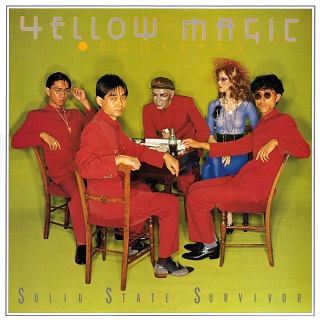
Yellow Magic Orchestra was, self-admittedly, the Japanese version of the German robots. What if these gentle “robots” infused in jazz chords would have broken into the mainstream before Kraftwerk, and Dusseldorf would have only remained a national treasure?
I believe that without Kraftwerk, the precision and angular German-ness might be present only in a smaller proportion in electronic music. Four-on-the-floor wouldn’t automatically mean that it’s quantized kicks on downbeats, sequenced basslines wouldn’t be necessarily repeated as 1/8th or 1/16th notes or as octave-alternating straightforward sequences, bass lines wouldn’t predominantly have short decay and very short-release VCA envelopes – as they often do today. In other words, a higher proportion of electronic music would be less “tight”, and maybe more… …French. Maybe softer, likely more textural, probably groovy and rhythmically varied yet easily dance-able genres would be the default “EDM”. That is, at least until 1990 and DnB in the U.K. and later in 2010 Skrillex bringing rhythm-based electronic music into the U.S. mainstream. (But wait, would DnB have been the same without the counter-culture role it had in Eurodance times? And, would Skrillex have made the same debut album in 2010 without the influence of Kraftwerk-and-techno on baby Sonny during the 1990s? This is the paradox of synthception… noone knows… but likely, he’d be shredding metal today.)
In any case, while Germany’s influence was successfully pushed back in other areas during the 20th Century, they might have unknowingly won the long-term cultural influence on electronic music. (And Dusseldorf’s direction was relatable by many, far more than Berlin’s high art.) Their sharp character has influenced other areas as well; just think about cars. The passionate and adventurous Italians’ slogans are “Only those who dare, truly live – We are the Competition.” (Ferrari), and “Expect the Unexpected” (Lamborghini). Meanwhile, BMW’s slogan since WW2 has been “The Ultimate Driving Machine” (despite of this being a enormous lie). The automotive world could have been as graceful without the past 30 years’ German cars as the world of modern Japanese robots is without German robots in it.
I truly love the music of Kraftwerk and I’m glad that it got popular. Though looking at their influence today, maybe too popular?
An even more interesting conundrum is the role of counter-culture. Let’s say, if without Kraftwerk, electronic music would have evolved to be less quantized and less “raw” during the past 5 decades, would various types of non-electronic music have tried to counteract it less? With Disco Demolition Night never taking place, Afrika Bambaataa not having anything to steal, the Pet Shop Boys playing bass on bass guitar, and DJs having to know at least a little bit about harmonies, electronic music skeptics haters would have had to look for different targets… or just chill and make even more rock and pop. If a softer, more romantic form of electronic music had been the norm throughout the 1980s and ’90s, would have a different set of genres become more minimal, tight, quantized, aggressive by now? Or would we have reached the current aesthetic of block-y, rigid on/off notes in electronic music anyway, given the black-or-white binarity that’s already woven into so many areas of our overly-practical life today? This is as big of a philosophical question as you can expect to face when you hypothetically re-write the history of electronic music… so I’d rather look for the answers from Nietzsche Descartes.
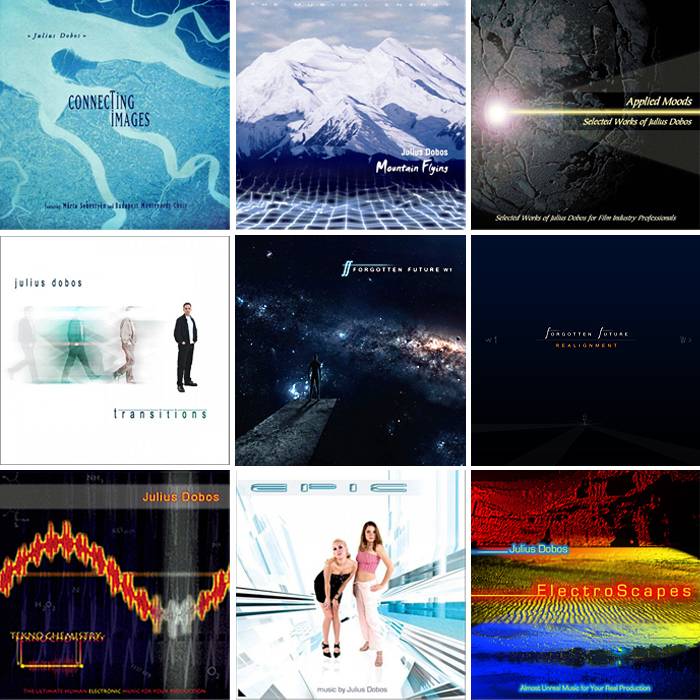
Creative Shop Music has announced the planned release of remastered, expanded editions of a range of Julius Dobos’ albums. The new series of releases will include the platinum album Connecting Images, the now-classic Mountain Flying, and Epic, among others. Aside from an improved sonic experience, fans can expect to find previously unreleased bonus tracks on some of the remastered editions. The new digital-only album releases are scheduled for 2022.